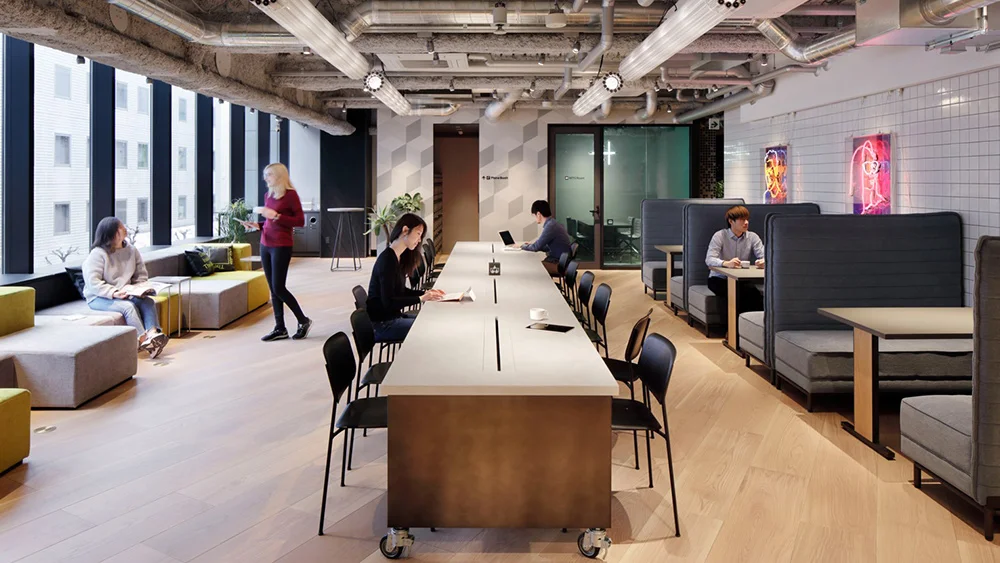
Hybrid work is basically the norm in 2026. People move between home and the office, teams are spread across time zones, and leaders still need a clear view of how their space is actually being used.
At this point, simple floor plans and basic booking tools just don’t cut it anymore. Organizations now look for workplace management software that can automate bookings, support safety, and give real data on what’s working.
All of this makes the DeskFlex vs OfficeSpace decision valuable. OfficeSpace is popular as a clean, simple office space management tool. DeskFlex, however, has grown into a complete hybrid workplace solution with broader features, more automation, and deeper industry support.
In this workplace management platform comparison, we’ll break down where each tool fits—and why DeskFlex is the stronger long-term choice for modern, hybrid organizations.
DeskFlex
DeskFlex is an all-in-one workplace management software platform designed for multi-location, compliance-heavy, and fast-scaling organizations. It goes far beyond basic desk booking and pulls multiple capabilities into a single system:
Desk booking and advanced hoteling
Room scheduling and conference room management
Built-in contact tracing for the workplace
Visitor management with configurable workflows
IoT sensors and real-time occupancy tracking
Asset and parking booking
Hybrid work management and hybrid workplace scheduling
Strong support for enterprise and multi-location rollouts
Since these tools are interconnected, DeskFlex becomes a central office space management hub that aligns people, space, and policies. It functions as a complete workplace ecosystem, and not just a point solution.
OfficeSpace
OfficeSpace focuses on desk booking and space planning with a clean and intuitive interface. There are lots of organizations that adopt it as an office space reservation tool for standard corporate workplaces. Its core strengths include:
Desk booking
Space planning and floor plan visualization
Room scheduling
Modern UI tailored to typical office environments
But where it falls short is in more advanced automation, safety capabilities, IoT integrations, and industry-specific workflows. From here, we can say that although OfficeSpace is a strong starter tool, DeskFlex offers a broader, more scalable feature set.
Feature-by-Feature Comparison — DeskFlex vs OfficeSpace
Desk Booking & Workspace Management
DeskFlex: DeskFlex gives you advanced hoteling with rules for zones, departments, and recurring bookings. Auto-release of unused desks, mobile and kiosk check-in, and a real-time office map make it easy to manage desk booking in busy offices. It creates a smoother team experience while supporting an efficient office space utilization system.
OfficeSpace: OfficeSpace offers you a clean booking interface and good floor plan mapping, which works well for simple layouts. However, automation and complex rules are more limited, making it a lot harder to support layered policies or diverse work patterns at scale.
Meeting & Conference Room Scheduling
DeskFlex: DeskFlex gives you a full room scheduling setup with calendar sync, resource booking, and auto check-in and check-out to cut down on no shows.
You can add digital room displays that show availability right away. Meanwhile, admins can set different rules per building or department, so bookings match the actual volume of people.
OfficeSpace: OfficeSpace includes basic meeting room scheduling with simple calendar integration. It works well for straightforward booking needs, but it is more limited when you need advanced workflows, detailed policies, or resource-level controls.
Contact Tracing & Workplace Safety
DeskFlex: Safety is built into DeskFlex, making it a strong partner for contact tracing workplace requirements. It uses IoT and Bluetooth sensors to capture proximity data, monitors occupancy, and triggers exposure alerts when risks arise.
It also includes compliance tools that make it easier to prove you are meeting health and safety guidelines.
OfficeSpace: OfficeSpace does not include built-in contact tracing or IoT-based safety automation. Teams that need those kinds of safeguards usually have to bolt on extra tools or fall back on more manual processes.
Visitor Management
DeskFlex: DeskFlex handles visitor management with custom forms, QR-entry, badge printing, and pre-registration as well.
Multi-site visitor logs give security and compliance teams a complete record of who entered, when, and why, which is critical for audits and investigations.
OfficeSpace: While OfficeSpace supports basic check-ins, it offers fewer options to adapt workflows for different buildings and departments.
See DeskFlex Live
Get a personalized walkthrough of the platform in 20 minutes.
IoT Integrations & Sensor Automation
DeskFlex: DeskFlex integrates with motion and heat sensors, plus beacons, to validate real-time presence and occupancy.
It improves space utilization analytics and supports rules that depend on actual use, not just reservations, unlocking smart-building use cases and energy savings.
OfficeSpace: OfficeSpace has limited hardware integrations. Users have fewer options to connect bookings with real-time presence or automate actions based on live occupancy.
Asset & Parking Space Reservations
DeskFlex: Beyond desks and rooms, DeskFlex also lets you reserve equipment, vehicles, tools, and parking spaces. That means employees can plan their entire office day in one place, from parking and desks to meeting rooms and devices, all inside a single platform.
OfficeSpace: OfficeSpace does not natively handle asset or parking bookings, so those resources usually end up managed in spreadsheets or separate tools.
Analytics and Reporting
DeskFlex: DeskFlex provides rich workplace analytics, including utilisation heatmaps, multi-department dashboards, hybrid work insights and exportable compliance reports. Leaders can see how spaces are actually being used, which days are busiest, and which areas might need to be resized or reconfigured.
OfficeSpace: OfficeSpace offers solid standard reports, but there is less flexibility when you need custom dashboards, more complex filters, or analysis across multiple locations.
Customization and Integrations
DeskFlex: DeskFlex is built to adapt to your workflows. It supports integrations with HRIS and Active Directory, calendar connectors for Google and Outlook, and API based automation.
Multi-location rules let you apply different policies by country, building, or business unit, all within one DeskFlex instance, while still managing everything from a central place.
OfficeSpace: OfficeSpace is more standardized, which simplifies setup but limits custom workflow design, complex approvals, and advanced integration scenarios.
Pricing & Value
DeskFlex: DeskFlex offers bundled feature packages that combine desks, rooms, safety, and workplace management software capabilities. Because the platform replaces multiple point tools, organizations typically see a lower total cost of ownership and more substantial ROI.
For many teams, DeskFlex becomes the best desk booking software choice when cost and capability are both considered.
OfficeSpace: OfficeSpace often prices desks, rooms, and additional features separately. As usage grows across locations and teams, overall costs can climb, especially when separate tools are needed for safety or advanced analytics.
Comparison Table — DeskFlex vs OfficeSpace
Feature | DeskFlex | OfficeSpace |
|---|---|---|
Desk Booking | ✔ Advanced | ✔ Basic |
Room Scheduling | ✔ Full | ✔ Basic |
Contact Tracing | ✔ Yes | ❌ No |
IoT Sensors | ✔ Yes | ❌ Limited |
Visitor Management | ✔ Enterprise | ✔ Basic |
Asset Booking | ✔ Yes | ❌ No |
Parking Booking | ✔ Yes | ❌ No |
Customization | ✔ Extensive | ❌ Limited |
Analytics | ✔ Deep | ✔ Good |
Industry Fit | ✔ Broad | ✔ Narrow |
Pricing | ✔ Better Value | ❌ Higher Cost |
Final Verdict: Why DeskFlex Is the Smarter Pick
When you put the two side by side, DeskFlex ends up being the better match for how modern hybrid workplaces actually run than OfficeSpace. It pulls together desk booking, room scheduling, visitor check-ins, contact tracing, IoT features, and analytics into one platform, so you don’t have to juggle a bunch of separate systems.
That means you’ll have fewer tools to manage, fewer data silos, and a more consistent experience for employees. It also means you can handle your policies, automate the day-to-day tasks, and manage your rules all in one place, instead of juggling a bunch of different systems. And since DeskFlex is highly customizable, it supports complex structures, multi-country deployments, as well as industries with strict regulations in ways OfficeSpace cannot easily match.
Its analytics capabilities and space utilization analytics give leaders clear visibility into how offices are really used, while safety and compliance features protect both people and operations.
When you put those strengths together with bundled pricing and lower long-term costs, DeskFlex becomes a powerful option for teams that are seriously considering an OfficeSpace alternative. It gives you an all-in-one, future-ready workplace platform that actually fits how modern hybrid organisations work today.