Hot desking is first-come, first-served. Hoteling is reservation-based. Both let employees share desks instead of having assigned seats — and both have become standard tools for hybrid workplaces in 2026.
The decision between them isn’t about which is “better” in the abstract. It’s about which fits your office attendance pattern, your team’s need for predictability, and how much technology your culture will accept. This guide breaks down hot desking vs hoteling across 10 dimensions, walks through the pros and cons of each, and gives you a clear framework for deciding — including when to use both together.
If you’re early in your hybrid work setup, start with our full guide to hot desking. If you’re comparing software options, see our 10 best hot desk booking systems. This post is for the moment you need to choose a model.
What is Hot Desking?
Hot desking is a workspace arrangement where employees have no assigned desks and instead use whichever workstation is available when they arrive. There’s no booking system, no reservation — employees show up and claim any open seat for the day, then clear it when they leave.
It’s the simplest flexible seating model and works best for organizations with informal cultures and below-50% in-office attendance. For a complete breakdown of how hot desking works, its history, and best practices, see our full guide to hot desking.
What is hoteling (or office hoteling)?
Office hoteling is a workspace model where employees reserve a desk in advance through a booking system, similar to booking a hotel room. Unlike hot desking, where any available desk can be claimed on arrival, hoteling guarantees the specific desk for a chosen time slot.
The term “hoteling” was coined in the early 1990s by Andersen Consulting (now Accenture), which pioneered the concept to manage office space for its consultants who were often traveling. The name comes directly from the hotel analogy: employees book a workspace the same way a traveler books a room.
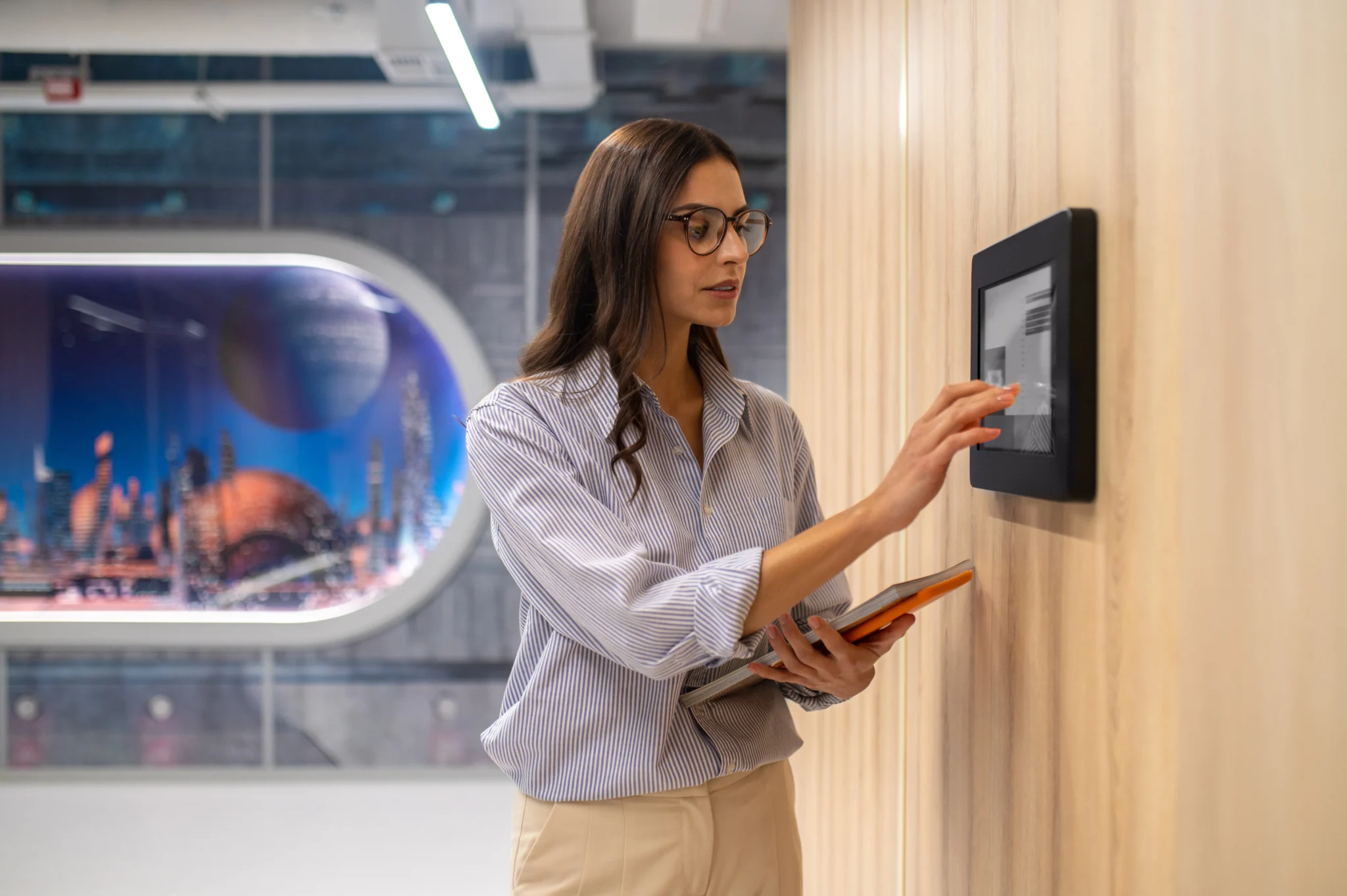
In a typical hoteling office, employees use a mobile app or web booking system to reserve a desk or workstation for specific dates and times. The system shows available hoteling desks on a floor plan, and employees pick the one that fits their needs proximity to teammates, equipment requirements, or quiet zones. When they arrive, they check in (via app, QR code, or NFC tap at a hoteling station), use the desk for their reserved time, and check out when they leave.
Hoteling space management software typically handles the booking workflow, while integrated occupancy sensors and analytics provide data on actual usage. This combination of reservation plus tracking is what distinguishes hoteling workspace systems from simple hot desking — and what makes them appropriate for organizations that need predictability, audit trails, or multi-location coordination.
Hot desking vs hoteling: side-by-side comparison
The two models share the same goal of flexible seating that maximizes office utilization but differ on critical operational dimensions. This hot desking vs hoteling comparison covers the 10 factors that matter most when choosing between them.
Feature Hot Desking Hoteling
Reservation Timing None first come first served Pre booked through a system
Predictability for Employees Low desks may run out High guaranteed seat
Admin Overhead Minimal no system to manage Higher booking system required
Employee Experience Spontaneous and less predictable Structured with fewer surprises
Tech Requirement Optional Required booking platform
Ideal Team Size Small to medium under 100 Medium to enterprise 100 plus
Ideal Use Case Informal culture with occasional office visits Hybrid teams with predictable attendance
Cost Impact Lower no software required Moderate booking software required
Collaboration Support Limited difficult to plan team seating Strong teams can book nearby desks
No Show Handling Self correcting another employee uses the desk Requires automatic release rules in software
Pros and cons of hot desking
Like every workspace model, hot desking has trade-offs. Here are the three biggest advantages and three biggest disadvantages from real deployments.
Advantages
Lower cost and complexity: There’s no software to buy or maintain, no admin time spent managing reservations, and minimal training required. For small offices, the simplicity is the point.
Maximum flexibility: Anyone can drop in on any day and find a seat without booking ahead, which suits teams that attend the office unpredictably.
Higher desk utilization: Compared to assigned seating, hot desking typically reduces required desk inventory by 30-50% in organizations with under 50% attendance rates — saving significant real estate costs.
Disadvantages
Desks can run out: During peak times, some employees may not find a workstation or may have to settle for poor locations far from teammates or equipment.
Teams can’t easily sit together: Without a booking system, coordinating co-location requires Slack messages, calendar tools, or showing up early — friction that reduces the value of in-office days.
No data on actual usage: Without tracking who used which desk and when, facilities teams can’t optimize the space or report utilization to leadership — making it harder to justify office investments.
Pros and cons of hoteling
Hoteling solves some of hot desking’s biggest weaknesses but introduces new ones. The trade-off matrix:
Advantages
Guaranteed workstation: Employees who book a desk are certain they’ll have one when they arrive, eliminating the anxiety of “will I get a seat” on busy days.
Predictable team co-location: Booking systems let teams reserve adjacent desks or neighborhoods, making in-office collaboration days actually valuable for the work that requires them.
Rich utilization data: Every booking creates a record, giving facilities and HR leaders accurate insight into who’s using which spaces, when, and how often — data that drives real estate decisions.
Disadvantages
Requires booking discipline: Employees must remember to reserve a desk before coming in, and must cancel if their plans change. Without that, no-shows degrade trust in the system within months.
Technology dependency: The booking platform becomes infrastructure. If it goes down, the office workflow breaks — so vendor reliability and uptime SLAs become a real procurement consideration.
Less spontaneity: The system rewards planning over walking in. For organizations with truly fluid attendance patterns, this structure can feel rigid compared to hot desking.
When to choose hot desking?
Hot desking fits when your situation matches several of these criteria. The more that apply, the stronger the case.
Office attendance is below 50% and varies significantly week to week.
Example: a 50-person tech startup where most engineers come in 1-2 days a month for whiteboarding sessions.
The culture is informal and tolerant of unpredictability.
Example: a creative agency where the team is comfortable with “whoever shows up sits where they can.”
There’s no budget or appetite for booking software.
Example: a small office where the cost of any SaaS tool isn’t justified by the headcount.
Teams don’t need predictable co-location.
Example: independent contributors who don’t rely on sitting near specific colleagues to do their work.
You want to test flexible seating before committing to a system.
Example: a company piloting hybrid work that wants to see how often the office actually fills up before investing in tooling.
When to choose hoteling?
Hoteling fits when several of these apply. As with hot desking, the more that match your situation, the stronger the case for adopting it.
Office attendance is 50-80% with predictable patterns.
Example: a 200-person consulting firm where Tuesday-Thursday in-office days are the standard expectation.
Teams need to sit together on collaboration days.
Example: a product team running weekly design reviews where colocation matters for the meeting to work.
You operate across multiple locations or time zones.
Example: a global company where employees travel between offices and need to reserve space ahead via an office hoteling app.
You’re in a regulated industry that requires audit trails.
Example: healthcare or financial services where compliance demands a hoteling desk reservation system with a record of who used which workspace when.
You need utilization data to optimize real estate.
Example: an enterprise considering office downsizing that needs evidence of actual desk usage patterns before signing a new lease.
Can you use both? (Hybrid model)
Yes — many organizations run hot desking and hoteling side by side in the same office. This hybrid approach is sometimes called activity-based working or office neighborhoods, and it typically works like this.
Keep Exploring
More guides on workplace management, desk booking, and hybrid work.
Reservable zones (hoteling) handle spaces where predictability matters — quiet focus areas, collaboration neighborhoods, executive zones, or desks near specialized equipment. Employees book these in advance through a desk booking app.
Open zones (hot desking) handle spaces where flexibility is more valuable than certainty — touchdown desks near the entrance, casual seating near coffee areas, or hot seats for short visits.
The combination lets you serve different work patterns without forcing everyone into the same model. A consultant doing focused work books a quiet desk in advance; a colleague dropping in for an hour grabs a hot seat without overhead. This is what activity-based working looks like in practice.
Implementing the hybrid model requires desk booking software that supports both modes natively. DeskFlex handles reservation zones and walk-in seating in the same platform, with floor plan controls for designating which desks are bookable versus open. For organizations growing into hybrid work, this is the model most likely to scale without forcing a future re-platforming.
Conclusion
Hot desking and hoteling aren’t competing philosophies they’re two tools for the same problem: getting more value from flexible office space. Pick the one that fits your team size, attendance patterns, and tolerance for technology. Or run both, as more and more organizations are doing in 2026.