



A Complete Guide to Digital Workplace Solutions
In 2026, organizations are focusing on integrated digital workplace models as hybrid work arrangements, geographically dispersed teams, and real-time collaboration have become standard requirements. Companies that fail to embrace digital transformation promptly risk a fragmented system and reduced efficiency. The transition does not concern the introduction of additional software. It is building a connected digital ecosystem that achieves quantifiable results.
This article will talk about how workplace digitalization and digital workplace solutions are transforming the future of work.
What are Digital Workplace Solutions?
Digital workplace solutions comprise digital workplace software, workplace cloud platforms, AI workplace technology, and hybrid work software that enable collaboration and productivity regardless of location. A digital workplace platform serves one strategic environment, unlike isolated applications that combine communication, scheduling, analytics, automation, and governance.
Nowadays, staff are no longer satisfied with disjointed access to digital collaboration systems, regardless of their remote, on-site, or time zone-distributed location. As a result, organizations are experiencing increased operational costs and greater demand to streamline space. Digital workplace solutions offer real-time data analytics and information to support smarter decision-making.
Digital workplace strategies in companies are more likely to lead to increased productivity, better employee engagement, and cost control. Thus, it is no longer limited to convenience but has a direct effect on competition positioning.
Digital Workplace Solutions vs Traditional Digital Tools
Understanding the distinction between digital workplace solutions and conventional digital tools is crucial for long-term strategy. Here are some of the differences between digital workplace solutions and traditional digital tools.
Traditional Digital Tools
Traditional digital tools comprise individual applications designed to perform specific functions. One tool is used to manage meeting room booking, another to manage messaging, and another to monitor analytics. These tools are not often deeply integrated with one another, though they are helpful for specific tasks. This creates operational silos in which data are fragmented, and work processes are disorganized.
Digital Workplace Solutions
Digital workplace solutions are a cohesive system of communication, hybrid work software, workplace digital signage software, office automation, and data analytics within a digital workplace platform. Rather than having separate systems, organizations are now working with a single digital workplace. This makes the flow of information between departments smooth. Moreover, it provides the company with visibility and strategic direction.
| Category | Traditional Digital Tools | Digital Workplace Solutions |
|---|---|---|
| Core Structure | Standalone applications solving individual tasks | Unified digital workplace platform integrating multiple systems |
| Primary Advantage | Quick deployment for immediate needs | Centralized ecosystem supporting long term scalability |
| Data Visibility | Fragmented analytics across separate dashboards | Consolidated data analytics and insights in one view |
| Hybrid Support | Limited coordination for distributed teams | Built in hybrid work software and real time space management |
| Scalability | Expansion increases complexity and duplication | Scalable architecture aligned with enterprise growth |
| Primary Limitation | Creates silos and inconsistent reporting | Requires structured implementation and strategic planning |
Core Components of Digital Workplace Solutions
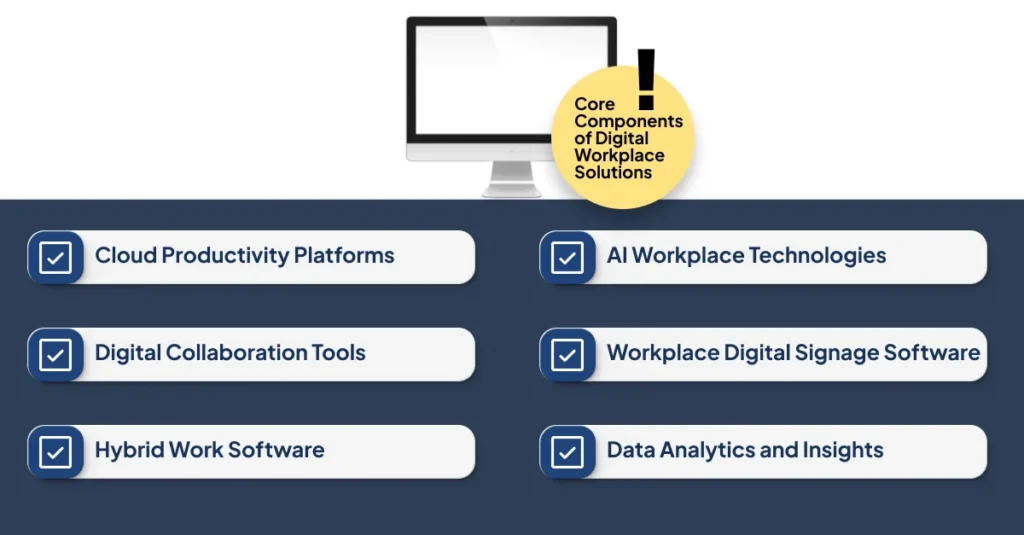
Integrated technologies that facilitate collaboration, hybrid work, automation, and analytics are the driving force behind digital workplace solutions. These components work together to form a whole, scalable digital working environment, some of which are:
1. Cloud Productivity Platforms
Cloud Platforms in workplaces offer the benefit of pooling enterprise documents, calendars, and work-related communications within a secure infrastructure. This allows the employees to work effectively irrespective of where they are. Cloud integration enables remote working and a digital workplace, while upholding governance and compliance requirements.
2. Digital Collaboration Tools
Online collaboration tools provide real-time messaging, video meetings, collaborative workspaces, and workflows. Collaboration is no longer unmeasurable when it is implemented in a digital workplace. Combined cooperation minimizes wasted time, speeds up processes, and improves cross-functional communication.
3. Hybrid Work Software
Desk and meeting room bookings, occupancy, and resource allocation are made possible by hybrid work software. This makes flexible work a system of coordination. Organizations with hybrid workplace solutions are informed about high-demand and low-demand areas, enabling cost optimization.
4. AI Workplace Technologies
AI workplace technologies help automate scheduling meetings, suggest optimal meeting times, and analyze workspace usage patterns. In the modern world, AI minimizes the coordination. This allows leadership to be reactive but predictive in their optimization.
5. Workplace Digital Signage Software
Digital signage software and digital sign software are used to increase communication in the physical spaces in the workplace. Signage systems will be directly linked to analytics platforms in digital ecosystems as they evolve, displaying live occupancy and booking data.
6. Data Analytics and Insights
Information is streamlined through data analytics and insights dashboards that combine data from collaboration, booking, and automation systems. Leaders can see utilization trends and workflow bottlenecks.
Real-World Applications of Digital Workplace Solutions

Online workplace solutions provide a quantifiable contribution in industries. When strategically implemented, they become more than just a convenience in operations and drive business performance.
These are some practical applications that show how digital solutions for the workplace are not mere IT upgrades but offer quantifiable benefits, adherence guarantees, and company-wide strategic acumen.
1. Enterprise Hybrid Teams
A consulting company with a hybrid operating model worldwide also experienced irregular office attendance. During busy days, meeting rooms would be overbooked, whereas an entire area of desks would be empty in the middle of the week.
The company implemented digital workplace software with occupancy analytics and hybrid work tools, traced usage patterns, and reallocated space accordingly. In a few months, they reduced real estate waste and improved coordination of departmental scheduling. This outcome included reduced overheads and easier collaboration on peak collaboration days.
2. Healthcare and Regulated Environments
A local hospital chain needed better visitor tracking and compliance reporting across several locations. Reporting delays and audit risks were created through manual processes.
The hospital implemented a digital workplace enterprise solution that included both visitor management and electronic sign software, as well as managed access logs and real-time reporting. Auditing on compliance was made quicker and more precise. The management became more visible as employees focused on patient care rather than administrative oversight.
3. Multi-Location Corporate Operations
A multinational corporation with offices in five cities had a piecemeal reporting system. The branches had their own booking tools and collaboration systems that restricted executive supervision.
Once systems were brought together into a single, diverse digital workplace platform, leadership received centralized analytics dashboards. Executives would be able to compare space utilization, collaboration frequency, and resource distribution across regions. Strategic planning shifted from assumption-based to data-driven decision-making.
Key Benefits of Digital Workplace Transformation
Digital workplace transformation helps organizations modernize operations, improve collaboration, and support flexible work environments. By integrating advanced technologies and workplace tools, companies can streamline processes, improve decision making, and enhance employee productivity.
1. Improved Operational Efficiency
Automation plays a major role in digital workplace transformation. It reduces repetitive manual tasks and accelerates communication across teams. As a result, employees can focus on higher value work instead of routine administrative activities.
2. Centralized Systems and Reduced Complexity
When organizations consolidate disconnected tools into a single digital workplace platform, operations become more streamlined. This integration eliminates data silos, reduces system complexity, and improves the accuracy and accessibility of business information.
3. Enhanced Employee Experience
User friendly digital collaboration tools make it easier for employees to communicate, share knowledge, and work together. Combined with hybrid work software, these tools support flexible work arrangements and help employees remain productive regardless of location.
4. Data Driven Decision Making
Analytics dashboards provide leaders with real time insights into workplace usage, collaboration patterns, and operational performance. With access to reliable data, organizations can make informed strategic decisions and allocate resources more effectively.
Challenges in Adopting Digital Workplace Solutions
While digital workplace solutions offer significant advantages, organizations often face several challenges during the transition. Successful adoption requires careful planning, employee engagement, and a clear strategy to ensure long term value.
1. Resistance to Change
One of the most common barriers is resistance from employees who are accustomed to traditional work processes. Teams that have relied on familiar tools and workflows may hesitate to adopt new digital workplace software. Organizations must provide clear communication, training, and support to help employees understand the benefits of the new systems.
2. Tool Overload and System Complexity
Many organizations already use multiple applications for communication, scheduling, and analytics. Introducing additional tools without proper integration can create confusion and inefficiency. Consolidating these applications into a unified digital workplace platform helps reduce complexity, improve governance, and create a more seamless work environment.
3. Limited Visibility of Return on Investment
Another challenge is the difficulty of measuring the direct impact of digital workplace transformation. Without proper analytics dashboards and reporting tools, organizations may struggle to evaluate improvements in productivity, collaboration, or workspace utilization. This lack of visibility can slow down adoption and reduce confidence in the new systems.
4. Delayed Value Without Data Insights
Organizations that do not prioritize data analytics early in the implementation process may struggle to realize the full value of their digital workplace solutions. Real time insights and performance metrics help leaders identify opportunities for optimization and demonstrate measurable improvements across operations.
Best Practices for Implementing Digital Workplace Solutions
One of the most effective ways of implementing digital workplace solutions successfully is to have a well-articulated strategy. Technology needs to align with quantifiable business objectives. These are some of the best practices that should be considered:
1. Integration
Expansion should be second to integration. There is no point in adding more tools without linking them, as this would only make the whole more complex, with siloed data and inconsistent reporting. The integration of systems in a single digital working environment brings about operational clarity.
2. Structured Onboarding
With well-planned onboarding, workers will learn not only how to use the digital workplace tools but also why they are essential. Clear direction during rollout reduces resistance and speeds up adoption. Introducing changes slowly and setting goals can help teams implement change more smoothly. Early wins boost trust and show how important it is for the workplace to become more digital.
3. Continuous Training
The digital workplace software is advanced, with ongoing improvements to features and AI workplace technologies. The ongoing training keeps the teams abreast with the latest capabilities and best practices. Continuous learning will prevent underutilization of tools and help the organization maximize the ROI of its digital workplace solution investment over the long run.
4. Adoption
The adoption measures success. The most sophisticated enterprise digital workplace system would not work even if employees consistently used it. Leaders will have to monitor engagement via analytics dashboards, receive feedback, and amend workflows, respectively. Sustainable adoption converts digital workplace solutions into IT projects that enable strategic growth.
Future Trends in Digital Workplace Solutions
Digital workplace solutions are not just about simple integration. Hybrid work digital solutions are the tools organizations use today to enhance flexibility and coordination. These systems will not only be reactive in the near future, but also become predictive in workforce planning.
1. AI-Driven Predictive Optimization
Existing AI technologies in the workplace are already minimizing scheduling fires and automating repetitive activities. The second is predictive intelligence, which predicts collaboration intensity, space demand, and workflow bottlenecks, and anticipates them as they may interrupt productivity.
As AI models grow, companies will no longer focus on analyzing past performance but will actively improve future results. This will enhance the proper allocation of space, minimize resource waste, and improve decision-making accuracy at the executive level.
2. Unified Digital Ecosystems
Many organizations are still operating in a partially connected system. The future of the digital workplace platform is complete ecosystems that bring communication, booking, analytics, and compliance into a single environment.
This will be a more integrated system that minimizes duplication, enhances reporting consistency, and supports scalability across the enterprise.
3. Automation-Powered Governance
Automation is no longer confined to workflow approvals. According to the digital workplace software, in the future, compliance checks, visitor entry rule checks, policy checks, and reports will be automated.
This is to reduce administrative overhead and minimize operational risk. With the maturity of automation, governance will change from a reactive to a proactive mode.
4. Data-Driven Employee Experience
Transforming the digital workplace is increasingly focused on the quantifiable employee experience. Today, occupancy and collaboration patterns are demonstrated in analytics dashboards.
These will be used to design workplaces for hybrid work schedules, and even for employee welfare programs. Experience will no longer be based solely on surveys, but on continuous data feedback loops.
5. From Optimization to Intelligent Orchestration
The future direction of digital workplace solutions is smart orchestration. Systems will not only link the tools, but also ensure they are coordinated with business priorities.
The predictive analytics, AI-based workplace technologies, and real-time dashboards will collaborate to continuously ensure adjustments to space, scheduling, and collaboration processes. Companies that adapt to this transformation will have agile, foresighted operations rather than being reactive.
Why DeskFlex Strengthens Your Digital Workplace Strategy
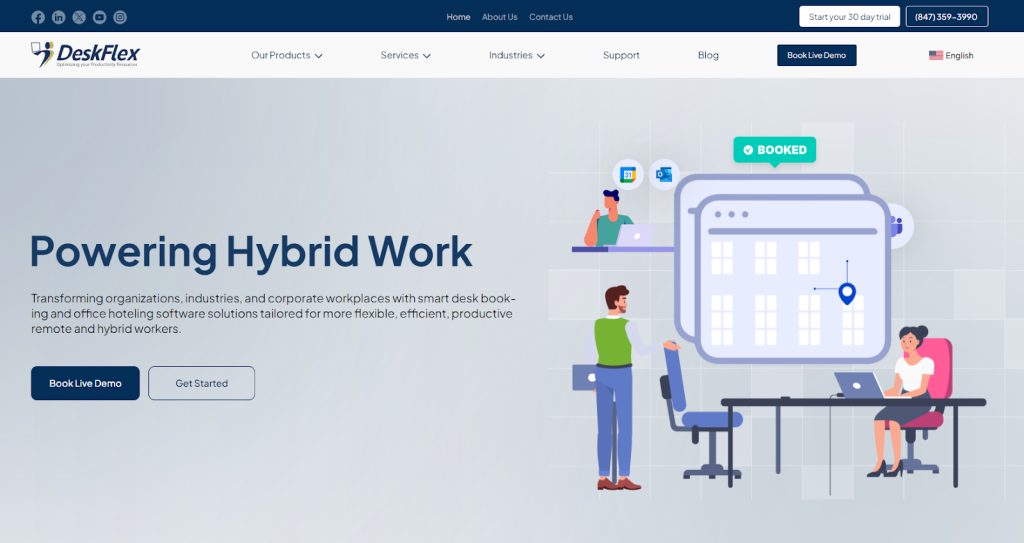
DeskFlex is a hybrid work software suite that includes meeting room management, desk booking, and a centralized analytics platform, all on a single, scalable platform.
Organizations can benefit from a single enterprise digital workplace ecosystem, enabling visibility and performance, rather than operating disconnected applications.
With DeskFlex, organizations can deploy to multiple locations, provide real-time occupancy updates, and explore using AI to plan schedules, especially when integrated with Digital signage software to display live availability and enhance workplace communication.
Upgrade to a Smarter Digital Workplace. Book a Demo Today!
Conclusion
Digital workplace solutions are no longer a luxury. They are the background to the contemporary strength and expansion of business. Organizations that invest in an integrated digital workplace system receive productivity, visibility, and scalability. Users who depend on disconnected systems risk inefficiency and stagnation. The future of work technology is combined, forecasting, and data-driven. The shift from digitalization to smart digital ecosystems is already underway.
Frequently Asked Questions (FAQs)
What is a digital workplace?
A digital workplace is an online platform that provides communication, collaboration, and business applications wherever workers are. It incorporates technology to enhance productivity, flexibility, and operational efficiency.
How do digital workplace solutions improve productivity?
They minimize redundant work, streamline scheduling, consolidate information reporting, and automate workflows. This reduces operational time delays and allows for quicker decision-making.
What is digital workplace transformation?
Digital workplace transformation involves shifting from disconnected digital tools to an integrated digital workplace platform. When technology aligns with business objectives and employee experience.
Why is digital workplace transformation important?
It helps organizations stay competitive in hybrid and remote settings. The transformation enhances scalability, operational visibility, and resilience in the long term.
What challenges do companies face when adopting digital workplace solutions?
Some common problems in implementing digital workplace solutions include reluctance to change, tool overload, and a lack of ROI visibility that can be overcome through strategic leadership alignment and progressive adoption.
What trends are shaping digital workplace solutions?
The future of digital workspace technologies is AI apps in the workplace, predictive analytics, integrated digital ecosystems, and workflows driven by automation.
Are digital workplace solutions scalable for enterprises?
Yes. Most digital workplace solutions nowadays are built on scalable platforms that enable deployment across numerous locations, centralized reporting, and scalability.
How do digital workplace solutions impact business performance?
Digital workplace solutions impact business performance by increasing operational efficiency, employee engagement, and providing evidence-based information. It supports strategic planning and competitive positioning.