Blog
Hotel Front Desk Software: Features, Benefits, and Best Solutions for 2026
Managing reservations, check-ins, billing, housekeeping, and guest communications manually is no longer realistic for hotels that want to stay competitive. Guest expectations have shifted decisively toward speed and digital convenience — and the software market is responding: the global hotel front desk software segment was valued at $1.25 billion in 2024 and is projected to reach $2.8 billion by 2033, growing at a CAGR of 9.5% (Verified Market Reports, 2025).
Hotel front desk software is a centralized digital solution that helps hotels automate front-office operations, improve staff productivity, and deliver a seamless guest experience from booking through checkout. Whether you’re running a boutique hotel, resort, motel, extended-stay property, or multi-location chain, the right system can transform daily operations and directly affect profitability.
Quick Comparison: Best Hotel Front Desk Software Solutions in 2026
| Software | Best For | Key Strength | Pricing |
|---|---|---|---|
| DeskFlex | Guest & visitor flow management | Real-time guest tracking, centralized front desk visibility, customizable workflows | Mid-market (Contact for quote) |
| Cloudbeds | Independent hotels | All-in-one PMS, channel manager, and booking engine | ~$200–$400/month |
| Mews | Automation-first properties | Self-service check-in, automation, open API ecosystem | ~$200–$450/month |
| Visual Matrix | Limited-service hotels | Easy-to-use housekeeping and front desk workflows | Contact for quote |
| RoomMaster | Small hotels and inns | Affordable reservation and guest management | ~$50–$150/month |
| Oracle OPERA Cloud | Enterprise hotel chains | Advanced revenue management and multi-property operations | Custom enterprise pricing |
At a Glance
- Best Overall for Front Desk Visibility: DeskFlex
- Best All-in-One Platform: Cloudbeds
- Best for Automation: Mews
- Best for Budget-Conscious Properties: RoomMaster
- Best for Limited-Service Hotels: Visual Matrix
- Best for Large Hotel Groups: Oracle OPERA Cloud
The right solution depends on your property’s size, operational complexity, and guest experience goals. Below, we’ll examine each platform in detail to help you determine the best fit for your hotel.
What Is Hotel Front Desk Software?
Hotel front desk software is a technology platform that helps reception and front-office staff manage guest reservations, room assignments, check-ins, check-outs, billing, payments, guest communication, and operational workflows from a single dashboard.
Often integrated with a Property Management System (PMS), it serves as the operational hub connecting reservations, housekeeping, maintenance, guest services, revenue management, and accounting. By automating repetitive tasks and centralizing guest data, hotels reduce errors, shorten wait times, and measurably improve guest satisfaction.
Why Hotels Need Front Desk Software
Guest expectations have moved firmly toward speed and self-service. According to the Hotel Tech Report 2025 State of Guest Technology:
- 58% of guests believe AI can improve their stay
- 43% of luxury guests expect zero wait time at check-in
- Nearly half prefer to check out via smartphone
- 68% say they’re more likely to choose a hotel offering mobile check-in (Oracle Hospitality)
Hotels still relying on spreadsheets or outdated systems typically struggle with long check-in queues, double bookings, billing disputes, poor interdepartmental communication, and delayed room readiness. The cost of these failures is well documented: the JD Power 2025 North America Hotel Guest Satisfaction Index Study — surveying nearly 39,000 guests across 102 brands — found that when problems occur during a stay, satisfaction scores fall by 217 points, translating directly into lost reviews, lost loyalty, and lost revenue.
Front desk software addresses these issues by giving staff real-time visibility into reservations, occupancy, housekeeping status, guest preferences, and financial transactions in one place.
How Hotel Front Desk Software Works?
Before Arrival
Front desk software organizes reservations, assigns rooms, and keeps guest data accurate before anyone walks through the door. This covers OTA booking synchronization, pre-arrival emails, payment pre-authorization, guest profile creation, and special request management — reducing overbookings and setting up a smoother check-in.
During Check-In
When guests arrive, the software surfaces reservation details, payment information, and preferences in a single dashboard, enabling digital registration, room allocation, payment processing, ID verification, and contactless or mobile check-in. Hilton’s Digital Key is now live in over 80% of its properties, with average check-in times under 60 seconds. Skift research links mobile check-in availability to meaningful gains in guest satisfaction scores.
During the Stay
Throughout the stay, front desk software connects front desk staff, housekeeping, and management — handling service requests, room changes, guest messaging, billing updates, and maintenance tracking. McKinsey & Company research finds that personalization can increase revenue by 10–15% in hospitality, making guest profile data in front desk systems a direct revenue driver.
During Checkout
At checkout, the software compiles charges, prepares invoices, collects payment, and initiates post-stay communication. Many systems support express checkout, reducing friction for guests who want a fast departure.
Key Features of Hotel Front Desk Software
Reservation Management
Manages bookings from multiple sources — direct website, phone, OTAs, travel agencies, and group reservations — while maintaining accurate room availability. Integration with channel managers and revenue tools is now standard across modern PMS platforms.
Guest Check-In and Check-Out
Streamlines arrival and departure through contactless check-in, mobile check-in, digital registration, automated room assignment, and express checkout. As of 2025, roughly two-thirds of global hoteliers had deployed at least one contactless solution, with mobile key and contactless check-in the most widely adopted categories (Dataintelo, 2026).
Billing and Payment Processing
Covers guest folios, automated invoicing, multiple payment methods, refund processing, tax calculations, deposit management, and split payment support. Automation in billing substantially reduces manual errors — including overbookings and pricing mistakes — freeing staff from time-consuming reconciliation.
Room Assignment Management
Lets staff view available rooms, assign rooms, handle upgrades, track occupancy, block rooms for maintenance, and monitor status in real time.
Housekeeping Integration
Provides live room status updates (Clean, Dirty, Occupied, Vacant, Inspected, Out of Order) alongside cleaning schedules, inspection tracking, task assignments, and maintenance alerts. The JD Power 2025 study identified room cleanliness as among the highest-impact factors on guest value perception.
Guest Profile Management
Stores stay history, contact information, preferences, loyalty status, special requests, and spending patterns — supporting personalized service and loyalty optimization that drive repeat bookings and ancillary revenue.
Reporting and Analytics
Tracks occupancy rates, ADR, RevPAR, booking sources, guest satisfaction trends, and staff productivity. Phocuswright (2025) found that hotels making the right technology investments achieve 18–28% higher RevPAR than those that don’t.
Multi-Property Management
For hotel groups and chains, centralizes reservations, shares guest profiles across locations, standardizes operations, and consolidates reporting from one dashboard.
Benefits of Hotel Front Desk Software
- Faster check-ins: Automated workflows, digital registration, and contactless options directly address the 43% of luxury travelers who now expect zero wait time at check-in.
- Improved staff productivity: Hotels deploying automation can reduce overtime requirements by 8–15%, while paper and printing costs fall by 60–80% through digitalization.
- Better guest experiences: Easy access to preferences and stay history helps hotels deliver tailored service. Global review volume rose 2.1% in 2025 as satisfaction trends improve (Hospitality Net / ReviewPro Benchmark Report, 2025).
- Fewer human errors: Automated booking management, accurate room assignments, and real-time data updates reduce costly mistakes from manual processes.
- Increased revenue: Digital upselling tools can generate 3–7% additional revenue through room upgrades and ancillary services, while CRM and direct booking tools can reduce OTA dependency by 10–25%.
- Better reporting and decision-making: With U.S. hotels generating $210 billion in room revenue in 2024 (American Hotel & Lodging Association), the ability to optimize pricing and occupancy based on accurate data is a meaningful strategic advantage.
Hotel Front Desk Software vs. Property Management System (PMS)
| Feature | Front Desk Software | Full PMS |
|---|---|---|
| Guest check-in / check-out | Yes | Yes |
| Reservation management | Yes | Yes |
| Billing | Yes | Yes |
| Housekeeping | Basic | Advanced |
| Revenue management | Limited | Extensive |
| Channel management | Limited | Full |
| Accounting | Limited | Advanced |
| Multi-property management | Optional | Comprehensive |
Front desk software focuses on reception operations. A PMS provides a complete hotel management ecosystem. The PMS segment holds the largest share (27.7%) of the broader hotel management software market in 2025, driven by demand for centralized platforms that handle reservations, front desk operations, billing, and guest services together (Coherent Market Insights, 2025).
Essential Integrations for Modern Hotels
- Channel managers synchronize inventory across Booking.com, Expedia, Agoda, and Airbnb — now a baseline expectation across modern platforms.
- Payment gateways accept secure payments through Stripe, PayPal, Square, and contactless options including Google Pay, Apple Pay, and WeChat Pay.
- Revenue management systems optimize pricing based on demand forecasts, competitor pricing, and occupancy levels.
- CRM systems improve guest engagement through personalized communications and loyalty program management.
AI-Powered Hotel Front Desk Software
AI adoption in hospitality is accelerating, with 58% of guests now believing AI can improve their stay (Hotel Tech Report, 2025). Modern systems increasingly include:
- AI guest messaging (automated responses to common inquiries)
- AI room assignment (smart allocation based on guest preferences)
- AI revenue optimization (predictive pricing recommendations)
- AI concierge services (dining and local attraction recommendations)
- AI forecasting (predicting occupancy trends and staffing needs)
AI-driven chatbots are already reducing front-desk workloads, freeing staff for higher-value guest interactions — particularly valuable amid ongoing hospitality labor shortages. Deloitte (2024) reports that AI-driven personalization boosts both guest satisfaction and hotel revenue.
Mobile and Contactless Operations
Mobile-enabled front desk software lets staff manage reservations, check room status, process payments, and communicate with guests from anywhere on the property. 62% of hoteliers are migrating operations to cloud-based PMS solutions (MARA Solutions, 2025), and mobile check-in adoption continues to accelerate among millennial and Gen Z travelers, who together account for over 54% of global hotel bookings in 2025 (Dataintelo, 2026).
Guest preference for self-service is reshaping front desk technology. More than 38% of branded hotel properties globally have transitioned from traditional key cards to NFC-based mobile keys, and over 72% of hotel operators in North America and Europe plan to expand contactless check-in infrastructure between 2025 and 2027.
Cybersecurity and Data Protection
Hotels handle sensitive guest and payment information. Software should offer PCI DSS compliance, data encryption, multi-factor authentication, secure cloud hosting, role-based permissions, and audit logs. Data protection is now considered a baseline expectation in enterprise hospitality technology, not a premium feature.
How to Choose the Right Hotel Front Desk Software?
- Ease of use. Front desk staff handle reservations, check-ins, billing, and guest requests all day. A clean, intuitive interface reduces training time and minimizes errors under pressure.
- Scalability. The system should handle increased bookings, additional users, and multiple properties without requiring a costly replacement as your operation grows.
- Integration capabilities. Should connect with your PMS, channel managers, payment gateways, accounting software, CRM platforms, and housekeeping tools out of the box.
- Customer support. Look for responsive support, onboarding assistance, training resources, and multiple contact channels — not just a ticketing system.
- Cloud accessibility. Cloud-based software allows access from any device, provides automatic updates, and removes the burden of on-premise IT maintenance.
- Security. Data encryption, secure cloud hosting, role-based access controls, automatic backups, and PCI DSS compliance are non-negotiable.
- Pricing and ROI. Hotel technology spending averages 3.5–5.5% of revenue (Phocuswright, 2025). Increasing to the 4–6% range tends to self-finance through revenue gains — so focus on total value, not the lowest monthly price.
Best Hotel Front Desk Software Solutions in 2026
1. DeskFlex — Best for guest and visitor flow management
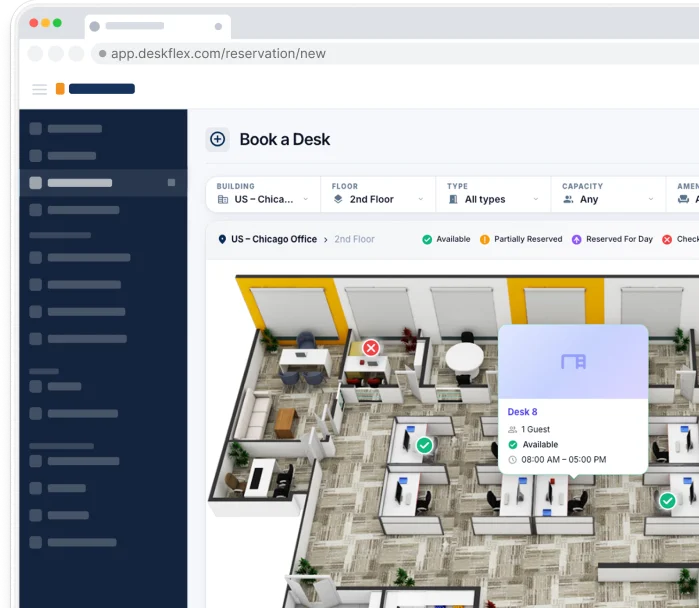
DeskFlex brings front desk operations into a single, cloud-based system built around real-time guest and visitor management. For properties where front-of-house staff are juggling arrivals, room status, and guest requests across multiple touchpoints, DeskFlex centralizes that coordination into one live dashboard — giving staff immediate visibility into who’s checking in, room readiness, and where guests need attention.
Key strengths: Real-time guest and visitor tracking, centralized front desk dashboard, customizable workflows for check-in and service requests, multi-location support for hotel groups, and analytics and performance reporting that help front-office managers spot bottlenecks before they affect guest experience.
Limitations: As a more specialized solution, it may require integration with a dedicated PMS or channel manager for full-service properties. Deep revenue management features are outside its primary scope.
Best fit: Hotels and hospitality groups looking to modernize front desk coordination — particularly properties with high guest traffic, multiple buildings or wings, or front-office teams that need a more responsive, real-time view of arrivals and guest flow than legacy systems provide.
Pricing: Mid-market
Request a free DeskFlex demo →
2. Cloudbeds — Best all-in-one platform for independent hotels
Cloudbeds combines property management, reservations, channel management, and guest communication tools in a single platform, with a strong marketplace of third-party integrations. It’s particularly well suited to independent hotels and boutique properties that want a single vendor covering both front desk and distribution.
Key strengths: Unified PMS + channel manager + booking engine, strong OTA connectivity, accessible pricing, and a user-friendly interface built for smaller teams.
Limitations: Reporting depth and revenue management tools lag behind enterprise platforms. Some users report that customer support response times slow as the company scales.
Best fit: Independent hotels, boutique properties, hostels, and vacation rentals wanting to consolidate tools without enterprise complexity.
Pricing: Mid-market (custom quotes based on property size; typically $200–$400/month range for small properties)
3. Mews — Best for automation-first and tech-forward properties
Mews is a cloud-native platform built around automation and self-service. Properties choose Mews specifically to minimize front desk staffing through guest-facing automation — online check-in, automated billing, and keyless entry. Its open API supports a large marketplace of integrations for hotels building a modular tech stack.
Key strengths: Aggressive automation, flexible API ecosystem, strong self-service guest journey tools, and a modern interface that resonates with digital-native teams.
Limitations: The automation-first philosophy means less hand-holding for properties that prefer traditional workflows. Some integrations in the marketplace require additional licensing fees.
Best fit: Design hotels, tech-forward boutiques, aparthotels, and any property actively working to reduce front desk headcount through automation.
Pricing: Mid-market (starts around $200–$450/month depending on property size and modules)
4. Visual Matrix — Best for limited-service and select-service brands
Visual Matrix focuses on front desk automation, housekeeping coordination, reporting, and guest service tools, with particular traction among limited-service and select-service hotel brands. It prioritizes operational simplicity over deep revenue management features.
Key strengths: Straightforward housekeeping workflows, ease of staff training, competitive pricing for limited-service operations.
Limitations: Not well-suited for full-service or luxury properties with complex F&B, spa, or concierge workflows. Revenue management capabilities are limited.
Best fit: Budget hotels, limited-service brands, economy and midscale properties where operational simplicity and low training overhead are priorities.
Pricing: Budget to mid-market
5. RoomMaster — Best for independent inns and boutique properties
RoomMaster is a reservation and guest management system aimed at independent hotels, inns, and boutique properties. Its strength is no-frills front desk and reservation functionality at a price point accessible to smaller operations that don’t need a full enterprise PMS.
Key strengths: Straightforward reservation management, accessible pricing, built specifically for smaller independent properties.
Limitations: Limited channel management depth and weaker integrations compared to Cloudbeds or Mews. Less suited to properties planning rapid growth.
Best fit: Independent inns, B&Bs, small boutique hotels, and owners who want reliable core functionality without paying for enterprise features they’ll never use.
Pricing: Budget tier (starts around $50–$150/month for small properties)
6. Oracle OPERA Cloud — Best for large hotel groups and enterprise chains
Oracle OPERA Cloud is the industry’s leading enterprise hospitality platform, built for large hotel groups and international chains that need advanced operational depth and scale across hundreds of properties. Oracle launched OPERA Cloud Central in January 2024, unifying data and functionality across modules under a single interface — a significant step for groups managing multi-brand, multi-country operations.
Key strengths: Deep revenue management, advanced distribution, enterprise-grade reporting, global compliance support, and a vast ecosystem of third-party integrations.
Limitations: High implementation cost and complexity; typically requires dedicated IT resources and a longer onboarding period. Not well-suited for independent or small properties.
Best fit: Hotel groups with 100+ properties, international chains, luxury brands with complex operational requirements.
Pricing: Custom / enterprise (contact Oracle for quotes)
Pricing Overview
| Solution | Best For | Pricing Tier | Starting Range |
|---|---|---|---|
| Oracle OPERA Cloud | Enterprise chains | Custom / enterprise | Contact for quote |
| Cloudbeds | Independent hotels | Mid-market | ~$200–$400/month |
| Mews | Automation-first properties | Mid-market | ~$200–$450/month |
| Visual Matrix | Limited-service brands | Budget–mid | Contact for quote |
| RoomMaster | Small independents | Budget | ~$50–$150/month |
| DeskFlex | Guest and visitor flow | Mid-market | Contact for quote |
Pricing estimates are based on publicly available information and vary by property size and modules selected. Always request a formal quote directly from vendors.
Cloud-based subscription models are now the industry norm, offering lower upfront costs and automatic updates compared to legacy on-premises systems. When evaluating cost, factor in implementation, training, and integration requirements alongside the monthly subscription fee.
Future Trends in Hotel Front Desk Technology
The next generation of hotel front desk software will be shaped by:
- AI-powered guest interactions and voice-enabled operations — from automated messaging to smart concierge
- Predictive staffing and smart room integrations (IoT) — connecting occupancy data with real-time energy and facilities management
- Biometric check-in and fully contactless guest journeys — facial recognition and NFC increasingly replacing key cards and manual ID checks
- Advanced revenue forecasting powered by machine learning — moving beyond static pricing rules toward dynamic, demand-driven optimization
- Sustainability tracking and carbon footprint reporting — increasingly required by corporate travel buyers and ESG-focused hotel groups
The global hospitality software market is projected to reach $5.88 billion by 2033 (Global Growth Insights, 2025). North America holds a 33.2% market share and is expected to maintain its lead as hotels accelerate digital transformation. Asia Pacific is projected to show the highest growth rate, driven by rapid hotel expansion and smartphone penetration exceeding 87% in markets like China, South Korea, Japan, and Singapore.
Conclusion
Hotel front desk software has become essential infrastructure for modern hospitality operations. By centralizing reservations, guest management, billing, housekeeping coordination, and reporting, these systems help hotels cut operational costs while delivering better guest experiences.
The direction is clear: hotels that invest appropriately in technology consistently outperform their peers — achieving 18–28% higher RevPAR, according to Phocuswright research. As AI, automation, and contactless technologies continue to mature, that performance gap is likely to widen.
Choosing the right system depends on your property type and operational priorities. Large chains need enterprise platforms like Oracle OPERA. Independent hotels benefit most from all-in-one solutions like Cloudbeds. Automation-first properties should look at Mews. Properties focused on tightening real-time guest and visitor flow will find that DeskFlex adds immediate, practical value at the front desk.
For hotels ready to streamline operations and raise service quality, implementing the right front desk software isn’t optional — it’s a foundational investment in long-term competitive advantage.
Ready to Transform Your Front Desk Operations?
Discover how DeskFlex can help your team streamline check-ins, improve guest experiences, and operate more efficiently from a single centralized platform. Request a free demo today and see how DeskFlex can help your hotel deliver faster service, better visibility, and a more seamless guest journey.
Frequently Asked Questions (FAQs)
What is hotel front desk software?
Hotel front desk software helps hotels manage reservations, guest check-ins, room assignments, billing, housekeeping coordination, and guest communications from a centralized system.
Is hotel front desk software the same as a PMS?
No. Front desk software focuses on reception operations, while a PMS manages broader hotel operations including revenue management, distribution, and advanced analytics. The PMS segment holds 27.7% of the hotel management software market in 2025 (Coherent Market Insights).
What features should hotel front desk software include?
Key features: reservation management, guest profiles, billing, reporting, housekeeping integration, mobile access, and payment processing. AI-powered messaging and predictive tools are increasingly standard in newer platforms.
Can small hotels benefit from front desk software?
Yes. Small hotels often see the most immediate gains — particularly from mobile check-in, automated billing, and real-time room management — because these features reduce the workload on small teams that can’t afford dedicated staff for every function.
Does hotel front desk software support mobile check-in?
Most modern solutions offer mobile and contactless check-in. It’s now expected by a majority of travelers, particularly millennials and Gen Z guests.
Is cloud-based front desk software better than on-premises?
For most properties, yes. Cloud-based systems provide easier updates, remote access, stronger scalability, and lower IT infrastructure costs. They now account for the majority of new hotel software installations.
How much does hotel front desk software cost?
Pricing ranges from roughly $50/month for small single-property solutions to custom enterprise pricing for large groups. Most mid-market platforms land between $200–$600/month depending on property size and features.


Support
Demo
Blog
Newsroom