


Blog

How Desk Hoteling Helps Companies Save Money and Improve Workplace Flexibility
Modern workplaces are rapidly evolving as organizations adopt hybrid work models and digital collaboration tools. One of the most effective solutions for optimizing office space while supporting flexible work is desk hoteling.
Desk hoteling allows employees to reserve a workspace in advance, similar to booking a hotel room, instead of having permanently assigned desks. This approach enables organizations to reduce operational costs while offering employees more freedom in how and where they work.
As companies rethink their office strategies in 2025 and beyond, desk hoteling is becoming a central part of modern workplace design.
What Is Desk Hoteling?
Desk hoteling is a reservation-based workspace management system where employees book desks, meeting rooms, or other workspaces ahead of time through scheduling software.
Unlike traditional offices where every employee has a dedicated desk, desk hoteling allows teams to use available workspaces only when needed. This system works particularly well for organizations with hybrid or remote employees who don’t require permanent office seating.
Typical features of desk hoteling systems include:
Desk reservation through mobile or web apps
Real-time workspace availability
Automated check-in and check-out
Workspace analytics and usage tracking
These tools help organizations manage office resources more efficiently.
Why Desk Hoteling Is Growing in Popularity?
The shift toward hybrid work has accelerated the adoption of desk hoteling worldwide. Several workplace trends explain this growth.
Hybrid Work Is Now the Standard
More than 70% of organizations support hybrid work schedules, meaning employees split their time between home and office.
Office Space Is Often Underutilized
Research shows that even on busy days only about 50% of office desks are used, leaving large portions of workspace unused.
Desk Sharing Is Becoming Common
Around 60% of North American employers now use desk sharing or hoteling models, and fewer companies maintain a one-desk-per-employee policy.
These trends make flexible desk management solutions increasingly valuable.
Key Benefits of Desk Hoteling for Organizations
1. Reduced Office Real Estate Costs
One of the biggest advantages of desk hoteling is cost savings. By sharing workspaces instead of assigning desks permanently, companies can significantly reduce the amount of office space they need.
Studies suggest organizations can save up to 30% in real estate costs after implementing office hoteling strategies.
Savings typically come from:
Smaller office leases
Lower utility and maintenance expenses
Reduced furniture and equipment costs
For large enterprises, these savings can translate into hundreds of thousands of dollars annually.
2. Better Workspace Utilization
Traditional office layouts often lead to wasted space because employees may not be present every day. Desk hoteling solves this issue by allowing multiple employees to share the same workspace at different times.
Organizations can maintain employee-to-desk ratios between 0.3 and 0.7, meaning fewer desks are needed for the same number of employees.
This data-driven approach helps companies optimize office layouts based on real usage patterns.
3. Greater Employee Flexibility
Desk hoteling empowers employees to choose the workspace that best fits their tasks and preferences.
For example, employees can book:
Quiet desks for focused work
Collaborative areas for team projects
Meeting rooms for presentations
Standing desks for ergonomic workdays
Providing this flexibility improves employee satisfaction and productivity.
4. Improved Collaboration and Networking
When employees are not tied to fixed desks, they can sit near different teams and departments. This dynamic environment encourages:
Cross-team collaboration
Knowledge sharing
Stronger professional relationships
Many organizations report improved teamwork after adopting flexible seating models.
5. Data-Driven Office Management
Desk hoteling platforms provide valuable analytics about workspace usage.
Managers can track:
Peak office days
Most-used desks or zones
Meeting room demand
Employee attendance patterns
These insights help organizations design more efficient office layouts and make better real estate decisions.
Desk Hoteling vs. Hot Desking
Although the terms are sometimes used interchangeably, desk hoteling and hot desking are different workplace strategies.
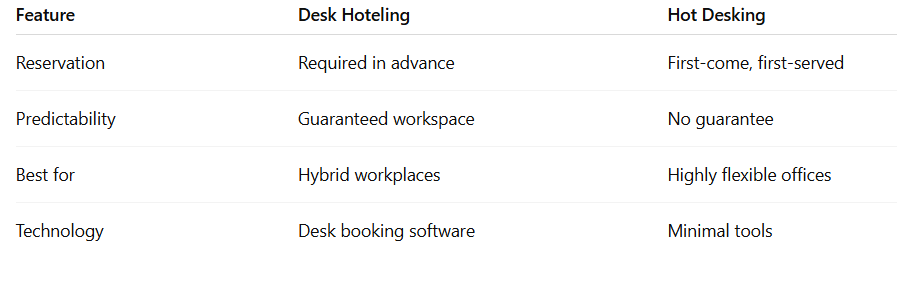
Desk hoteling provides more structure, making it easier for organizations to manage office space effectively.
Best Practices for Implementing Desk Hoteling
Organizations planning to introduce desk hoteling should follow a few key steps.
1. Analyze Workspace Usage
Conduct occupancy studies to understand how often employees use office desks and meeting rooms.
2. Implement Desk Booking Technology
Use desk hoteling software that integrates with calendars, mobile apps, and communication tools.
3. Create Flexible Work Zones
Design the office with a mix of workspaces such as collaboration areas, focus booths, and meeting rooms.
4. Establish Clear Policies
Define booking rules, check-in procedures, and etiquette to avoid reservation conflicts.
The Future of Desk Hoteling
As hybrid work continues to reshape modern offices, desk hoteling will remain an essential workplace strategy. By combining flexible seating, smart technology, and data-driven planning, organizations can build offices that support both productivity and cost efficiency.
Companies that adopt desk hoteling today are better prepared for the future of work—where flexibility, collaboration, and efficient space management define successful workplaces.
Frequently Asked Questions (FAQs)
What is desk hoteling in the workplace?
Desk hoteling is a workspace management system where employees reserve desks or workspaces in advance using booking software. Instead of having assigned desks, workers book available workstations when they need them, which helps companies optimize office space and support hybrid work.
How does desk hoteling work?
Desk hoteling works through a reservation system where employees select a workspace using a mobile app or web platform. They choose a desk, meeting room, or collaboration area for a specific date and time. The system confirms the reservation and tracks office space availability.
What are the benefits of desk hoteling?
Desk hoteling offers several advantages for organizations and employees, including:
Lower office real estate costs
Better workspace utilization
Increased employee flexibility
Improved collaboration between teams
Data insights for office space planning
These benefits make desk hoteling a popular solution for hybrid workplaces.
What is the difference between desk hoteling and hot desking?
Desk hoteling requires employees to reserve desks ahead of time, while hot desking operates on a first-come, first-served basis. Desk hoteling provides more structure and guarantees workspace availability, while hot desking offers more spontaneity but less predictability.
Why are companies adopting desk hoteling?
Companies are adopting desk hoteling because hybrid work has reduced the need for permanent desks. Many offices have unused workstations on certain days, so desk hoteling helps organizations save money, improve space utilization, and create more flexible work environments.
Is desk hoteling suitable for hybrid work?
Yes, desk hoteling is especially effective for hybrid workplaces. Employees who only come to the office a few days per week can reserve desks when needed, allowing companies to reduce office space while still supporting in-person collaboration.