DeskFlex

Want to see DeskFlex in action? Book your live demo today!

Blog

How to Strengthen Workplace Connection and Transparency

How to Strengthen Workplace Connection and Transparency in Hybrid Teams (Without Surveillance): The 2026 Guide

In 2026, the word “transparency” has become loaded in workplace conversations. On one hand, hybrid teams genuinely need transparency to function: visibility into who is in the office, real-time room availability, equitable access to leadership, fair recognition regardless of location. On the other hand, “transparency” is now the marketing word that surveillance tools use to justify themselves. Microsoft Teams’ Wi-Fi-based location tracking, the rapid growth of employee monitoring software like Hubstaff, ActivTrak, and Teramind, and aggressive return-to-office mandates have produced widespread concern that workplace transparency is sliding into workplace surveillance under another name. The line between coordination and control has blurred.

This guide is the complete 2026 reference on how to strengthen workplace connection and transparency in hybrid teams without crossing into surveillance. It covers what healthy workplace transparency actually means in 2026, the seven principles that distinguish it from surveillance, five red flags that “transparency” is actually monitoring in disguise, the proximity-bias and equitable-visibility challenges that hybrid teams face, eight practices that build connection without becoming Big Brother, the manager-level playbook for sustaining trust in distributed teams, and the technology choices that support coordination without enabling surveillance. Whether you are an HR director rewriting workplace policy, a manager building a hybrid team, an executive setting tone from the top, or an employee trying to understand what is happening to your workplace, this guide gives you a clear framework.

What is workplace transparency in 2026?

Workplace transparency in 2026 is the practice of making operational, organizational, and decision-making information appropriately visible to the people affected by it, so they can coordinate work, contribute fairly, and trust the organization to act in good faith. Healthy workplace transparency covers things people need to know to do their jobs and feel fairly treated. It explicitly does not cover continuous monitoring of individual employee behavior, biometric tracking, productivity scoring, or other surveillance disguised as openness.

The distinction matters because the same word is now used for two opposite practices. Genuine transparency includes:

  • Coordination transparency: who is in the office today, which rooms are booked, when meetings are happening, who is on which team
  • Organizational transparency: company strategy, financial health, decision-making rationale, role and salary frameworks
  • Equity transparency: how promotion and compensation decisions are made, who is being considered for opportunities, how feedback is collected
  • Process transparency: how requests are evaluated, what the policy says, who has authority to decide what

Surveillance disguised as transparency includes:

  • Continuous keystroke and mouse-movement tracking
  • Screenshot capture at intervals
  • Biometric monitoring (eye tracking, fidgeting, body language)
  • Wi-Fi-based location tracking without consent
  • Productivity scoring algorithms
  • Webcam monitoring during work hours
  • Application and website usage tracking
  • AI-powered “engagement” scoring of meeting participation

Both sets of practices are increasingly marketed under the word “transparency.” The 2026 challenge is distinguishing them in policy, in technology choices, and in everyday practice.

Why the transparency vs surveillance question defines 2026

The intersection of three trends has made workplace transparency the most-contested workplace topic of 2026:

1. Hybrid work made coordination harder

When everyone came to the office five days a week, coordination happened through proximity. You could see who was at their desk, who was in a meeting, who was at lunch. Hybrid work removed that automatic visibility, which created genuine coordination problems that workplace technology needs to solve. Healthy transparency (real-time room availability, team presence visibility, anchor-day coordination) is the answer.

2. The employee monitoring industry exploded

Between 2020 and 2026, the employee monitoring software industry grew rapidly. Tools like Hubstaff, ActivTrak, Teramind, Time Doctor, Veriato, and dozens of others now collect comprehensive data on individual employees: keystrokes, screen content, application usage, location, biometric signals. Most market themselves as productivity or “transparency” tools. Recent surveys suggest 60 to 80 percent of organizations now use some form of employee monitoring software, often without employees fully understanding the scope.

3. Big Tech blurred the line

In late 2025, Microsoft Teams introduced Wi-Fi-based location tracking that automatically detects when employees are in the office and shares that information with managers. The feature is marketed as a coordination tool for hybrid work. Critics, including workplace researchers and labor advocates, called it a turning point in mainstream workplace surveillance: a tool that millions of organizations use suddenly capable of automated location tracking. The broader question, whether large collaboration platforms are evolving into surveillance platforms under the banner of transparency, is now central to workplace technology decisions.

4. Return-to-office mandates created enforcement pressure

Many organizations introduced or strengthened return-to-office mandates between 2023 and 2026. Some mandates include attendance enforcement through badge swipe data, Wi-Fi tracking, or manager observation. The enforcement function has driven demand for monitoring tools that can verify compliance, blurring the line further between coordination data and surveillance data.

5. The trust dividend has become measurable

Employees increasingly weight workplace surveillance into their employment decisions. Surveys from Future Forum, Gartner, and various HR research bodies suggest that perceived surveillance is one of the strongest negative drivers of engagement, retention, and recruiting. Organizations that lean into surveillance pay a measurable price in talent outcomes; organizations that build transparency without surveillance gain a measurable advantage.

The decisions organizations make about technology, policy, and practice in 2026 will define the workplace experience for the next decade.

Workplace transparency and monitoring by the numbers

Statistic Figure Source
Organizations using some form of employee monitoring software 60–80%+ Industry Surveys (2024–2026)
Knowledge-work organizations operating hybrid work ~70%+ Gartner; Future Forum Pulse
Employees who report surveillance concerns affecting workplace satisfaction Significant majority Various HR Research
Productivity uplift in trust-based vs. surveillance-based workplaces 15–25% Workplace Research Synthesis
Voluntary turnover reduction from genuine workplace flexibility 25–35% Gartner HR Research
Year Microsoft Teams introduced Wi-Fi-based location tracking Late 2025 Microsoft Teams Release Notes
Employee monitoring software market growth rate 15–20% CAGR Industry Analysis
Engagement uplift in comfortable workplaces 15% Harvard Business Review
Real estate cost reduction from coordination-led consolidation 30–50% CBRE; Verdantix
Reduction in commute emissions from 3 office days vs. 5 ~40% Industry Calculations

These figures are referenced throughout the sections below.

The 7 principles of healthy workplace transparency

Healthy workplace transparency, the kind that builds trust rather than erodes it, follows seven principles. Programs that violate any of them tend to slide toward surveillance regardless of stated intent.

Principle 1: Transparency serves coordination, not control

The fundamental test. Is the information being shared because people need it to do their jobs (coordination), or because someone wants to monitor someone else (control)? Real-time room availability passes the test (employees need it to find available space). Continuous screen recording fails the test (employees do not need to monitor each other’s screens to do their jobs).

Principle 2: Information flows both ways

In healthy transparency, employees have visibility into the organization (strategy, decisions, rationale) at least as much as the organization has visibility into them. Asymmetric transparency, where leadership sees everything employees do but employees see almost nothing of leadership decision-making, is the hallmark of surveillance disguised as openness.

Principle 3: Consent and clarity are non-negotiable

Employees understand exactly what is being tracked, why, who can see it, how long it is retained, and what decisions it informs. Tracking features turned on by default without explicit informed consent (the Microsoft Teams Wi-Fi tracking pattern) fail this principle even if the data itself would be acceptable with proper consent.

Principle 4: The minimum necessary data, not the maximum possible

Healthy transparency collects only the data needed for the stated purpose. Surveillance, even when well-intentioned, tends to collect everything possible “in case it is useful later.” A booking system that records who booked which desk passes; a system that records the same plus keystroke patterns, biometric signals, and behavioral analytics fails.

Principle 5: Individual privacy is preserved at the personal level

Aggregate, anonymized data (utilization by floor, attendance by week) is appropriate for facilities and operations decisions. Individual-employee monitoring (this specific person was at this specific desk for this many minutes, took this long to respond, visited these websites) is surveillance and requires the highest possible bar to justify.

Principle 6: Algorithms and AI are explainable

If algorithmic systems are scoring or evaluating employees in any way, employees can see exactly what the algorithm considers, how it weights factors, and how to appeal or correct outputs. Black-box productivity scoring or AI-driven “engagement” rankings without explainability fail this principle even if the underlying intent is benign.

Principle 7: Equitable access regardless of physical location

Transparency systems explicitly correct for proximity bias rather than reinforce it. Remote employees get the same visibility into opportunities, recognition, and decisions as in-office employees. Systems that make remote workers invisible to leadership while making in-office workers visible fail this principle even if no surveillance is involved.

5 red flags that “transparency” is actually surveillance

The five clearest red flags that workplace “transparency” is actually surveillance are: tracking individual behavior at high granularity (keystrokes, mouse movement, screen content, biometric signals), collecting data without explicit consent or opt-out, using collected data to score or rank individual employees, asymmetric data flow where leadership sees everything but employees see nothing back, and using the data primarily for enforcement rather than coordination.

Red flag 1: Individual-level high-granularity tracking

Keystroke logging, mouse movement tracking, screen recording, application usage logging, biometric monitoring (eye tracking, posture, facial expression), and continuous Wi-Fi-based location tracking all collect individual employee behavior at a granularity that exceeds any legitimate coordination need.

The test: Could the same coordination outcome be achieved with aggregate or self-reported data? If yes, the individual-level tracking is surveillance.

Red flag 2: No real consent

If the tracking feature is turned on by default, if consent is buried in employment agreements that employees did not negotiate, if there is no genuine opt-out without career consequences, or if the scope of what is tracked is not clearly disclosed, the system is operating without real consent regardless of legal compliance.

The test: If employees genuinely understood the full scope of what is being tracked and how it is used, would they agree? Workplaces where the answer is uncertain are operating without real consent.

Red flag 3: Used for individual scoring or ranking

When monitoring data is used to score individual employees on productivity, engagement, or performance, the system has crossed from coordination to evaluation. Even when scores are not directly tied to compensation or termination, the chilling effect on behavior is the surveillance effect.

The test: Is the data used for collective decisions (where should we put more meeting rooms) or individual decisions (is this employee productive enough)? Individual scoring is the bright line.

Red flag 4: Asymmetric information flow

When leadership has comprehensive visibility into employee behavior but employees have minimal visibility into leadership decisions, the strategy, or how decisions affecting them are made, transparency has become surveillance.

The test: Can a typical employee describe the company’s strategic priorities, recent leadership decisions, and the reasoning behind them as accurately as a manager could describe that employee’s recent behavior? Asymmetry indicates surveillance.

Red flag 5: Primarily used for enforcement

When monitoring data is used to enforce return-to-office mandates, attendance policies, or other compliance requirements, the system has shifted from voluntary coordination to enforcement infrastructure. Enforcement tools tend to expand: what starts as attendance verification often becomes performance evaluation, then disciplinary action.

The test: Was the system introduced primarily to solve a coordination problem or to enforce a policy? Enforcement origins typically produce surveillance outcomes regardless of stated intent.

Proximity bias and equitable visibility in hybrid teams

The most common transparency failure in hybrid teams is not surveillance overreach. It is the opposite: proximity bias that makes remote employees invisible while in-office employees gain disproportionate visibility, opportunity, and recognition.

What proximity bias looks like

  • The manager who shares casual conversations with in-office team members but never with remote ones
  • The promotion that goes to the in-office employee because they were “more visible” during the year
  • The opportunity announced in a hallway conversation that remote employees never hear about
  • The recognition for work where in-office contributors get more credit because they were physically present at the relevant meetings
  • The performance review that weights “presence” alongside output, disadvantaging remote contributors

Research on proximity bias (Stanford Bloom studies, Harvard Business Review, various workplace research) consistently shows that remote workers in hybrid arrangements face measurable disadvantages in promotions, opportunities, and pay if managers do not actively counteract proximity bias.

How transparency helps counteract proximity bias

Healthy workplace transparency specifically corrects for proximity bias by:

  • Making team presence visible to everyone: not just to managers but to all team members, so remote and in-office workers have the same situational awareness
  • Documenting decisions in writing: rather than making them in hallway conversations
  • Recording and sharing meeting content: so remote workers have the same access to discussion as in-office attendees
  • Tracking opportunity allocation: explicitly monitoring whether remote vs in-office employees are getting equal access to high-visibility projects
  • Reviewing promotion patterns: checking whether promotion outcomes track to actual contribution rather than physical presence
  • Default-async communication: building communication patterns where information is documented and shared rather than transmitted ambient

How surveillance reinforces proximity bias

Counterintuitively, employee monitoring software often reinforces proximity bias rather than counteracting it. When managers can see continuous data on remote employees but rely on impression for in-office employees, they tend to scrutinize the remote workers more closely and notice every absence or perceived dip in activity. The monitoring data creates the illusion of objective evaluation while actually amplifying the location-based bias the manager already has.

The healthy alternative is to manage by outcomes regardless of location: remote and in-office employees are both evaluated on what they deliver, not on activity logs (for remote) or perceived presence (for in-office).

8 practices for building connection without surveillance

Healthy workplace transparency requires intentional practice. The eight habits below consistently distinguish organizations that build strong hybrid connection from organizations that drift toward control.

Practice 1: Default to async written communication

When decisions and information live in written, searchable channels (documents, Slack, project management tools), everyone has equal access regardless of where they are or when they work. Verbal hallway communication, by contrast, privileges whoever happened to be present. The shift to async written communication is the single highest-leverage move for hybrid transparency.

Practice 2: Use anchor days, not attendance enforcement

Anchor days are specific days when teams agree to come to the office together for collaboration. The agreement is collective and outcome-focused, not enforced through monitoring. The result is higher attendance on the right days, better collaboration when in the office, and freedom from monitoring on other days. See our office hoteling best practices guide for anchor-day implementation.

Practice 3: Make presence data visible to peers, not just managers

Healthy team-presence visibility shows colleagues which teammates are coming in today so people can coordinate. The same information shared only with managers becomes attendance monitoring. The fix is technical and political: peer-visible presence data builds team coordination; manager-only presence data drifts toward surveillance.

Practice 4: Document leadership decisions and rationale

The strongest single move for organizational transparency is publishing the reasoning behind significant leadership decisions: why a strategy shifted, why a role changed, why a policy was introduced. Employees who understand the reasoning trust the organization. Employees who only see outcomes assume the worst.

Practice 5: Hybrid-first meetings, not in-office-first

When meetings are run as hybrid-first (everyone joins from their own device, even those in the same building), remote participants are not visually marginalized and the meeting experience is consistent regardless of location. Hybrid-second meetings (where in-office attendees gather in a room with a small camera and remote attendees appear as thumbnails) consistently produce proximity bias.

Practice 6: Explicit opportunity broadcasting

When new projects, promotions, or opportunities exist, announce them widely rather than letting them spread through informal networks. The informal network reaches in-office employees first; explicit broadcasting reaches everyone equally.

Practice 7: Recognize contribution regardless of location

Public recognition (in team meetings, in company communications, in awards) should reflect actual contribution, not location. Audit recognition patterns annually: are remote workers receiving recognition proportional to their contribution, or are in-office workers over-represented?

Practice 8: Manager check-ins focused on support, not surveillance

Regular one-on-ones with managers focused on “what do you need” and “what is blocking you” rather than “what did you do this week” support remote and in-office employees equally. The support orientation builds trust; the verification orientation erodes it.

The manager’s playbook for hybrid team trust

Managers are the most important variable in whether hybrid teams build healthy transparency or drift toward surveillance. The four foundational practices for managers leading hybrid teams:

1. Manage outcomes, not activity

The single most important shift. Define what each team member is responsible for delivering. Measure delivery. Provide support. Do not measure activity (hours worked, applications used, time at desk). Activity measurement creates surveillance pressure; outcome measurement builds trust.

2. Schedule deliberate one-on-ones

Weekly or biweekly one-on-ones with every team member, in-office or remote. Topics: what they are working on, what they need from you, what is blocking them, how they are doing. Not topics: did you come in this week, why were you offline at 3pm.

3. Be visible yourself

If you expect transparency from your team, model it. Share your own calendar, your reasoning on decisions, your own work-in-progress. Asymmetric leadership (you see them, they do not see you) erodes trust faster than almost any other manager behavior.

4. Counteract your own proximity bias

Actively notice whether you are giving more attention to in-office team members than remote ones. Ask remote team members what they need. Bring them into casual conversations through async channels. Watch your own promotion and opportunity recommendations: are remote contributors getting their share?

Technology choices that support transparency without surveillance

The technology stack matters because tools embody values. Some tools are built for coordination; others are built for surveillance. The distinction is not always obvious from marketing, but the underlying design tells the story.

Coordination-first technology (good for transparency)

  • Desk and room booking systems that show real-time availability without tracking individual usage in detail
  • Calendar systems with shared visibility into who has time available
  • Team-presence visibility at the team level, not the individual surveillance level
  • Documented decision-making through wikis and knowledge bases
  • Async communication through Slack, Teams chat, project management tools
  • Outcome-focused performance management through OKR systems and goal-tracking
  • Workplace analytics at the aggregate level (floor utilization, peak hours) not the individual level

Surveillance-first technology (problematic regardless of marketing)

  • Keystroke logging and mouse tracking software
  • Screen recording or screenshot capture at intervals
  • Application and website usage tracking at the individual level
  • Continuous location tracking through Wi-Fi, badge swipes, or device monitoring
  • Webcam monitoring during work hours
  • Productivity scoring algorithms that rank individual employees
  • AI-driven “engagement” or “attention” scoring of meeting participation or work activity
  • Biometric monitoring including eye tracking, posture, body language

The grey zone

Some technology can be configured either way. The classic example is meeting-room and desk-booking systems: the same booking data can be used to coordinate work (aggregate utilization for facilities planning) or to monitor employees (which specific person was where for how long). The configuration and policy choices determine which side of the line a particular deployment falls on.

DeskFlex’s approach is to provide coordination data while explicitly avoiding surveillance functionality. The platform tracks bookings and check-ins for operational purposes (real-time availability, abandoned-booking release, utilization analytics) but does not collect or report individual behavior at the surveillance level (no keystroke logging, no screen recording, no biometric monitoring, no productivity scoring, no continuous location tracking beyond the booking and check-in events the employee initiates).

How DeskFlex supports transparency without surveillance

DeskFlex is a workplace coordination platform specifically built for the right side of the transparency vs surveillance line.

What DeskFlex tracks (and why)

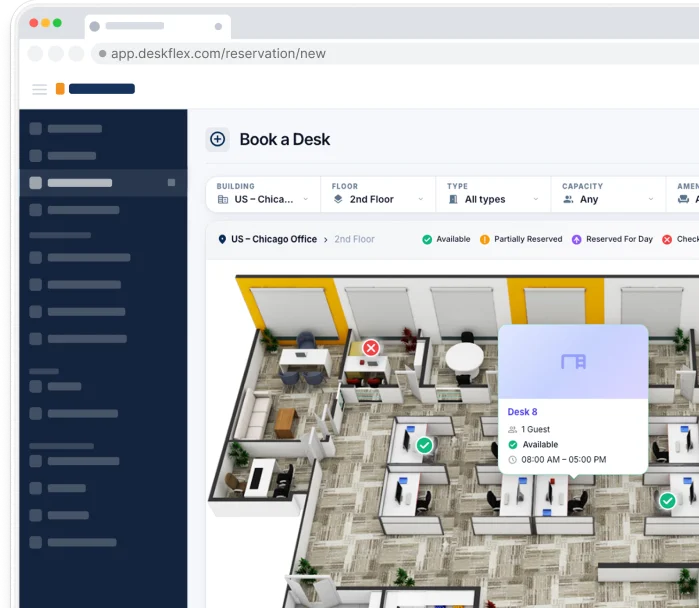
  • Booking data (who reserved which desk, room, or workspace, when), to manage real-time availability and prevent double-bookings
  • Check-in events (employee confirming presence at the booked space), to enable auto-release of unused bookings and real-time visibility into occupancy
  • Utilization analytics at the aggregate level (zone usage, peak hours, attendance patterns), to support facilities and real-estate decisions
  • Visitor records for visitor management, to support security and host notification

What DeskFlex explicitly does not track

  • No keystroke logging or mouse-movement tracking
  • No screen recording or screenshot capture
  • No application or website usage tracking
  • No continuous location tracking beyond the booking and check-in events employees initiate
  • No biometric monitoring of any kind
  • No productivity scoring of individual employees
  • No AI-driven behavior or engagement scoring

Privacy-respecting design

  • Aggregate analytics rather than individual surveillance dashboards as the default
  • Configurable retention so booking data does not become a permanent surveillance archive
  • Role-based access so utilization data is visible to facilities and IT, not to every manager looking at every report
  • On-premise deployment option for organizations with data-residency or sovereignty requirements
  • GDPR-aligned data handling for EU customers
  • Transparency in what is tracked and how it is used, available in product documentation rather than buried in privacy policies

How DeskFlex enables healthy transparency

  • Desk booking supports hybrid coordination without individual surveillance
  • Check-in events are initiated by the employee, not by ambient tracking
  • Room scheduling with abandoned-meeting protection releases unused rooms automatically, no enforcement needed
  • Team-presence visibility through team-day-coordination features rather than individual surveillance dashboards
  • Visitor management for security and welcome workflows
  • Workplace analytics at the aggregate level for real-estate and operations decisions
  • Native integrations with Microsoft 365, Outlook, Google Workspace, Okta, and Microsoft Active Directory that respect existing identity and privacy controls

Book a 30-minute demo to walk through how DeskFlex supports your specific transparency and coordination needs.

Conclusion

Workplace transparency in 2026 is genuinely valuable for hybrid teams: coordination data lets people collaborate, organizational transparency builds trust, and equitable visibility counteracts proximity bias. But the word “transparency” has been increasingly used to justify surveillance: keystroke logging, screen recording, biometric monitoring, location tracking, and productivity scoring all marketed as transparency tools. Distinguishing the two has become one of the most important workplace strategy questions of the decade.

The seven principles, five red flags, and eight practices in this guide give workplace leaders the framework to build genuine transparency without sliding into surveillance. The single most important shift is moving from activity measurement to outcome measurement, from individual tracking to aggregate analytics, from enforcement-driven monitoring to coordination-driven visibility, and from asymmetric data flow to mutual transparency between organization and employees.

Technology choices matter because tools embody values. Coordination-first platforms (booking systems, calendar visibility, async communication, aggregate analytics) build transparency. Surveillance-first platforms (keystroke logging, screen recording, behavior tracking, productivity scoring) erode it regardless of how they are marketed. DeskFlex is built specifically for the coordination side of this line, with explicit limits on what the platform tracks and how the data is used. If your organization is building hybrid team transparency and wants technology that supports it without becoming surveillance, book a 30-minute demo to walk through the platform’s approach.

Frequently Asked Questions (FAQs)

Workplace transparency is the practice of making operational, organizational, and decision-making information appropriately visible to the people affected by it, so they can coordinate work, contribute fairly, and trust the organization to act in good faith. Healthy transparency covers things people need to know to do their jobs and feel fairly treated (real-time room availability, team coordination, strategic decisions, role and pay frameworks). It explicitly does not cover continuous monitoring of individual employee behavior, biometric tracking, productivity scoring, or other surveillance disguised as openness. The 2026 challenge is distinguishing the two in policy, in technology choices, and in everyday practice.

Healthy transparency serves coordination (helping people do their work and trust the organization) while surveillance serves control (monitoring individual behavior to verify compliance or evaluate performance). The five clearest signs that “transparency” has crossed into surveillance are: individual-level high-granularity tracking (keystrokes, screen recording, biometrics), lack of real informed consent, use for individual scoring or ranking, asymmetric data flow where leadership sees everything but employees see nothing back, and primary use for enforcement rather than coordination. The same technology can sometimes fall on either side of the line depending on configuration; the policy and intent determine which.

Seven principles guide healthy hybrid team transparency: (1) transparency serves coordination not control; (2) information flows both ways between leadership and employees; (3) consent and clarity are non-negotiable; (4) collect the minimum necessary data not the maximum possible; (5) individual privacy is preserved at the personal level; (6) any algorithms or AI involved are explainable; and (7) equitable access regardless of physical location. The eight specific practices that implement these principles are: default to async written communication, use anchor days rather than enforcement, make presence data visible to peers not just managers, document leadership decisions and rationale, run hybrid-first meetings, broadcast opportunities explicitly, recognize contribution regardless of location, and run manager check-ins focused on support rather than verification.

Proximity bias is the tendency to favor people who are physically nearby, particularly in workplace decisions about promotion, opportunity allocation, recognition, and evaluation. In hybrid teams, proximity bias means in-office employees receive disproportionate visibility, opportunity, and recognition compared to remote employees doing equivalent work. Research from Stanford (Bloom), Harvard Business Review, and various workplace researchers consistently shows that remote workers face measurable disadvantages in hybrid arrangements unless managers actively counteract proximity bias. The strongest interventions are async-first communication, default-hybrid meetings, explicit opportunity broadcasting, outcome-based performance management, and managerial awareness training.

Equitable visibility is the practice of ensuring that remote and in-office team members have the same access to leadership, opportunities, recognition, and information regardless of where they physically work. It is the active counter to proximity bias. Six practices typically support equitable visibility: documented decision-making, hybrid-first meetings, async-first communication, deliberate opportunity broadcasting, regular manager check-ins with remote team members, and annual review of promotion and opportunity patterns to check for proximity bias.

Avoid workplace surveillance by following five rules: collect only the minimum necessary data for clearly stated coordination purposes; require explicit informed consent for any individual-level data collection; never use behavioral data for individual scoring or ranking; ensure information flows both ways (employees see organizational decisions as clearly as the organization sees employee behavior); and route enforcement through human conversation rather than automated monitoring. In technology choices, prefer coordination-first tools (booking systems, calendar visibility, async communication) over surveillance-first tools (keystroke logging, screen monitoring, behavior tracking). In policy, distinguish clearly between aggregate data for facilities and operations decisions vs individual data that has surveillance implications.

In late 2025, Microsoft Teams introduced a Wi-Fi-based location tracking feature that automatically detects when employees are in the office and shares that information with managers. Whether it constitutes surveillance depends on implementation: if enabled by default without explicit informed consent, used for individual employee evaluation, accessible to managers without employee visibility into the same data, or used for return-to-office enforcement, it crosses the line into surveillance. If enabled only with explicit opt-in, used for collective coordination rather than individual evaluation, with employees having full visibility into when they are detected, it could potentially be configured for coordination use. Most organizations have implemented it closer to the surveillance side than the coordination side, which has driven much of the 2026 workplace transparency debate.

Coordination-first technology supports transparency: desk and room booking systems (real-time availability, no individual behavior tracking), calendar systems with shared visibility, team-presence visibility at the team level, documented decision-making through wikis and knowledge bases, async communication channels, outcome-focused performance management, and workplace analytics at the aggregate level. Surveillance-first technology is problematic regardless of marketing: keystroke logging, screen recording, application tracking, continuous location tracking, webcam monitoring, productivity scoring algorithms, and biometric monitoring. The same technology can sometimes fall on either side depending on configuration; the booking platform that tracks aggregate room usage for facilities planning is coordination, while the same data used to score individual employees by office time crosses into surveillance.

Research consistently shows that perceived workplace surveillance erodes trust, engagement, and retention. Various workplace surveys find that employees subject to comprehensive monitoring report lower job satisfaction, higher stress, reduced creativity, and increased intent to leave. The negative effects are often largest for the highest-performing employees, who tend to have more options and are less willing to tolerate surveillance. Organizations using monitoring software typically pay a measurable price in talent outcomes that often exceeds the productivity gains the monitoring was intended to produce. The trust dividend (avoiding monitoring) tends to be larger than the monitoring efficiency gain.

Coordination data answers questions about how to organize work: which rooms are free, who is coming to the office today (at the team level), when meetings are happening, what desks are available. Surveillance data answers questions about individual behavior: what is this specific person doing right now, how productive are they, where exactly are they at this moment. Coordination data is typically aggregate or self-initiated (an employee booking a desk creates booking data); surveillance data is typically individual and ambient (a system collecting behavior without user action). The line is not always perfectly clean, but the distinction matters because the same word (“transparency”) is often used to describe both, when only one is healthy.

Four principles separate healthy hybrid management from micromanagement: manage outcomes not activity (define deliverables, measure delivery, do not measure hours or application usage), schedule deliberate one-on-ones focused on support not verification, model the transparency you expect by sharing your own calendar and decisions, and actively counteract your own proximity bias by paying equal attention to remote and in-office team members. Managers who follow these practices consistently produce higher engagement and retention than managers who default to surveillance even with the same headline policies.

Aggressive return-to-office mandates have driven much of the 2026 surveillance growth by creating enforcement demand. When organizations need to verify whether employees are complying with attendance mandates, they often deploy monitoring tools (badge tracking, Wi-Fi detection, manager observation) that go well beyond what coordination requires. The mandate-enforcement-surveillance cycle has produced widespread employee concern and is one of the strongest predictors of the current debate over workplace transparency. Organizations that avoid this cycle either by not mandating return-to-office aggressively or by using anchor days and team coordination rather than enforcement consistently see better outcomes on engagement and retention.

DeskFlex is built specifically for coordination rather than surveillance. The platform tracks bookings and check-ins for operational purposes (real-time availability, abandoned-booking release, utilization analytics) but explicitly does not collect or report individual behavior at the surveillance level: no keystroke logging, no screen recording, no biometric monitoring, no productivity scoring, no continuous location tracking beyond the booking and check-in events employees initiate. Aggregate utilization analytics are the default; individual surveillance dashboards are not part of the product. Role-based access ensures that even the data that exists is accessible only to facilities, IT, and other operational stakeholders rather than to every manager. For organizations specifically seeking employee monitoring functionality, DeskFlex is not the right tool; the right tools are explicit surveillance platforms (Hubstaff, ActivTrak, Teramind, others) that DeskFlex is intentionally not similar to.

Healthy workplace transparency consistently produces measurable business outcomes: higher engagement (typically 15 to 25 percent uplift in trust-based vs surveillance-based workplaces), lower voluntary turnover (Gartner research shows 25 to 35 percent reduction with genuine flexibility and trust), faster recruiting (transparent workplaces attract better candidates), better collaboration through reduced friction, faster decision-making through documented context, and reduced legal and reputational risk by avoiding the privacy concerns that come with surveillance. The business case for transparency without surveillance is strong even before considering the moral and trust-building dimensions.

Six characteristics distinguish workplace platforms that respect employee privacy from those that drift toward surveillance: data minimization (collects only what is needed for stated purposes), explicit consent (employees understand what is tracked and why), aggregate-first analytics (individual data not the default), role-based access (operational data accessible only to operational stakeholders), configurable retention (data does not become a permanent surveillance archive), and transparency in tracking (what is collected is documented clearly rather than buried). DeskFlex follows all six. Surveillance-first platforms typically fail at least three of the six.