DeskFlex

Want to see DeskFlex in action? Book your live demo today!
Flexible Office Space

What Is Flexible Office Space? Complete 2026 Guide (Types, Benefits, Design & Management)

Roughly 70 percent of knowledge-work organizations now operate in some form of flexible office model rather than fixed assigned-seat offices (Gartner; JLL workplace surveys 2024 to 2026). The shift has been driven by three forces: hybrid work attendance making traditional one-desk-per-person ratios obviously wasteful, the rise of mature coworking and serviced office options like WeWork, Regus, and Industrious, and the development of workplace technology that makes flexible models actually workable day to day. The result is a market where “flexible office space” can mean very different things depending on who is using the term.

This guide is the complete reference for flexible office space in 2026. It covers what the term actually means in both of its common uses (external coworking versus internal flexible design), the eight main types, the measurable benefits and real challenges, the design principles that separate flexible offices that work from ones that fail, the technology required to operate them, and the practical guidance for deciding whether and how flexible office space fits your organization. Whether you are evaluating coworking memberships, redesigning your own office for flexibility, or trying to manage a flexible space you already have, this guide covers what you need.

What is Flexible Office Space?

Flexible office space is any workspace arrangement that adapts to changing needs rather than fixing each employee to a permanent desk in a permanent layout. It includes external flexible workspaces (coworking, serviced offices, on-demand spaces from providers like WeWork, Regus, or IWG) and internal flexible offices (your own office redesigned with hot desks, hoteling, neighborhoods, activity-based working zones, and reconfigurable layouts). The defining characteristic of flexible office space is that where and how employees work can change to match what they are doing, rather than being locked to a single fixed desk.

In practice, flexible office space answers a different question than traditional offices. Traditional offices ask “where does each person sit.” Flexible offices ask “what spaces does the work actually need today.” Some employees still need quiet focus rooms, others need open collaboration zones, others need private call booths, and the mix changes day to day. A well-designed flexible office provides all of those spaces and lets employees choose, while a well-rented flexible office gets that variety on a shorter, cheaper lease than a traditional office could provide.

Flexible office space is closely related to several adjacent concepts that often appear in the same conversation:

  • Hot desking is shared seating with no reservation (first come first served)
  • Hoteling is shared seating with advance reservation
  • Coworking is shared workspace open to multiple organizations
  • Serviced offices are private offices in shared buildings, all-inclusive pricing
  • Activity-based working is workspace design built around the type of work being done
  • Hybrid work is the broader work model that flexible office space enables

For a comparison of hot desking and hoteling specifically, see our hot desking vs hoteling guide. For the broader range of flexible work arrangements, see our flexible work arrangements guide.

The Two Meanings of Flexible Office Space: External vs Internal

The term causes real confusion because it is used for two distinct things. Being clear which one you mean matters because the decisions, vendors, and costs are completely different.

External Flexible Office Space (rented from a provider)

This is what most people mean when they search “flexible office space near me.” It refers to coworking spaces, serviced offices, hot desk memberships, and on-demand workspaces rented from providers like Regus, WeWork, IWG, Industrious, Mindspace, Servcorp, and thousands of local coworking spaces.

External flexible office space is best for:

  • Startups that need professional space without a multi-year lease
  • Distributed teams needing meeting space in a city where they do not have an office
  • Project teams needing temporary space
  • Companies testing a new market before committing
  • Freelancers and remote workers needing a professional environment

The buying decision is essentially a real estate decision: which provider, which location, which membership tier, what lease term, what amenities. Providers like Regus and WeWork compete on the comparison points like price, location coverage, amenities, and contract flexibility.

If you are looking for external flexible office space, the most useful resources are coworking provider websites and aggregator sites that compare options in your city.

Internal Flexible Office Space (your own office, designed for flexibility)

This is the meaning workplace and facilities leaders use when they design or redesign their own office to be flexible. It refers to the layout, technology, and management of a company-owned or company-leased office that gives employees variety in where and how they work.

Internal flexible office space is best for:

  • Hybrid organizations whose attendance varies day to day
  • Companies right-sizing real estate against actual attendance
  • Organizations whose work mix has diversified (some focus, some collaboration, some calls)
  • Companies pursuing employee experience or productivity gains
  • Mature organizations modernizing legacy assigned-seat offices

The buying decisions are workplace strategy decisions: floor plan, zone mix, furniture, technology stack (desk booking, room scheduling, visitor management, analytics), policy. Workplace platforms like DeskFlex, Robin, Eptura, and OfficeSpace compete here.

If you are designing or operating an internal flexible office space, the rest of this guide is written for you. If you are looking for external flexible office space, the section above lists the right providers and the rest of this article still gives you context on what makes flexible office spaces work well.

Flexible Office Space by the Numbers

Stat Figure Source
Knowledge-work organizations now operating flexible office models ~70%+ Gartner; Future Forum Pulse
Typical reduction in desk count when shifting to flexible (hoteling-based) 30 to 50% Industry benchmarks
Real-estate cost savings when occupancy data drives consolidation 30 to 50% CBRE Global Workplace and Occupancy Insights; Verdantix
Office desks unused on any given weekday in fixed-seat offices Up to 40% Leesman, JLL
Typical desk-to-employee ratio in mature flexible offices 0.5 to 0.7 CBRE benchmarks
Productivity uplift commonly reported in well-designed flexible environments 15 to 25% Stanford / Bloom hybrid studies
Voluntary turnover reduction associated with meaningful workplace flexibility 25 to 35% Gartner HR research
Global flexible office space market size ~$30 billion+ JLL flex office market reports
Annual growth rate of the flexible workspace market 15 to 20% JLL; Cushman & Wakefield

The 8 Types of Flexible Office Space

Flexible office space covers a wider range of arrangements than most discussions recognize. The eight common types:

1. Hot desking

Shared workstations with no reservation. Employees arrive and claim any available desk. Simplest model to set up, most common in small offices, but creates morning friction when attendance is unpredictable.

2. Hoteling

Shared workstations with advance reservation. Employees book a specific desk for a specific time through a desk booking app, check in on arrival, and the desk releases back to the pool when they leave. Now the dominant model in mid-market and enterprise hybrid offices. See our office hoteling best practices guide for the complete playbook.

3. Activity-based working (ABW)

Workspaces designed around activities rather than employees: focus rooms for deep work, collaboration areas for team work, phone booths for calls, social areas for informal interaction. Employees move between zones based on what they are doing. The most ambitious flexible office model when implemented well.

4. Team neighborhoods

Specific zones of the office reserved for specific teams on specific days. Anchors hybrid scheduling by giving teams a “home” while still sharing the underlying space when teams are not in. Works well when paired with anchor-day scheduling.

5. Coworking spaces

Shared workspace open to multiple organizations, ranging from local independent spaces to global networks like WeWork, Regus, and IWG. Pay-per-use, monthly, or annual memberships. Best for individuals, small teams, and distributed organizations needing space in multiple cities.

6. Serviced offices

Private offices in a shared building, all-inclusive pricing covering rent, utilities, internet, furniture, cleaning, and shared amenities (reception, meeting rooms, kitchen). The middle ground between coworking and traditional lease. Common for growing companies that want their own space without the operational overhead.

7. Drop-in and on-demand workspaces

Pay-per-hour or pay-per-day access to professional workspace, often booked through apps. Useful for remote workers needing occasional professional space, traveling employees, and companies experimenting before committing to longer-term arrangements.

8. Modular and reconfigurable spaces

Physical office spaces designed to be physically reconfigured: movable walls, modular furniture, raised floors with rerouteable power and data. Allows the same square footage to be reshaped as needs change. Higher capital cost upfront but much lower change-cost over the building’s lifetime.

Most modern offices combine two or three of these. A typical mature hybrid office might use hoteling for desks, activity-based working for zone design, team neighborhoods for anchor days, and have a coworking membership for satellite locations.

Benefits of Flexible Office Space

The benefits of flexible office space fall into six categories, with the specifics varying depending on whether you are using external (coworking, serviced) or internal (your own redesigned office) flexible space.

1. Lower real estate costs

The most visible benefit. For external flexible space, the savings come from avoiding multi-year leases, build-out capex, and operating expense for spaces you do not consistently use. For internal flexible space, the savings come from desk count reduction (30 to 50 percent typical) and floor consolidation based on real attendance data. Both routes typically deliver 30 to 50 percent real estate cost reduction over two to three years (CBRE, Verdantix).

2. Better hybrid work support

Flexible office space gives hybrid employees somewhere productive to be when they come in. Fixed assigned seating in a hybrid context means desks sit empty most of the time and the remaining attendees feel isolated. Flexible space concentrates attendance into zones that feel populated and productive.

3. Higher productivity through space-work matching

When employees can choose the space that fits their task (quiet for focus, collaboration zones for team work, phone booths for calls), productivity rises 15 to 25 percent compared to one-size-fits-all offices, according to multiple studies including the Stanford / Bloom hybrid work research and various workplace ROI surveys.

4. Easier scaling up and down

For growing companies, flexible space scales with the team. Coworking memberships add or remove seats month to month. Internal flexible space, designed around shared seating, absorbs growth before requiring more square footage. Both avoid the over-build / under-build cycle that traps companies in fixed leases.

5. Improved employee experience and retention

Employees consistently rank workspace flexibility as a top-five workplace satisfaction driver. The retention effect is strong: meaningful flexibility correlates with 25 to 35 percent lower voluntary turnover according to Gartner HR research. Working parents, caregivers, and employees with long commutes especially value flexibility.

6. Faster talent acquisition

Coworking and serviced offices let companies open in new markets without lease commitments, which accelerates hiring in talent-rich cities. Internal flexible spaces with strong remote work integration broaden the candidate pool. Both effects show up in faster time-to-hire and lower cost-per-hire metrics.

Flexible Office Space Pros and Cons

Both external and internal flexible office space have real downsides alongside the benefits. Naming them honestly is what separates a thoughtful workplace strategy from a marketing pitch.

Pros of flexible office space

  • Cost flexibility: lower commitment for external, lower square footage for internal
  • Faster scaling: add or remove space as needed
  • Better hybrid work fit: concentrates attendance and matches space to actual use
  • Variety of work modes: focus, collaboration, calls, social, all in one office
  • Productivity gains: when space matches work mode
  • Higher employee satisfaction: when implemented well
  • Reduced commute time: for distributed teams using satellite coworking
  • Lower carbon footprint: through right-sized real estate and reduced commuting

Cons of flexible office space

  • Coordination friction: colleagues sit further apart, spontaneous collaboration drops
  • Set-up time loss: finding a desk, finding a room, setting up each morning costs 10 to 20 minutes per day
  • No personalization: no photos, no permanent setup, no “your” desk
  • Equity issues: some employees (those with accessibility needs, parents) value consistency, and pure flexible models can disadvantage them
  • Technology dependency: flexible offices fail without good booking, scheduling, and presence-visibility tools
  • Noise and distraction: when zones are not enforced properly, focus zones become call zones
  • Manager resistance: leaders accustomed to assigned seating sometimes struggle
  • Hidden costs for external space: coworking premiums, meeting-room charges, member-cost creep over time

The strongest flexibility programs acknowledge these downsides and design around them: accommodation policies for accessibility, locker storage for personal items, anchor-day scheduling for team coordination, strict zone rules for noise management, and integrated workplace technology to remove daily friction.

Flexible Office Space Design Principles

Whether you are designing your own flexible office or evaluating a coworking provider, the same design principles apply. These are the eight that consistently appear in flexible offices that actually work.

1. Variety over uniformity

A flexible office needs at least five distinct types of space: focus zones (quiet, individual), collaboration zones (group work, casual meetings), formal meeting rooms (closed-door, equipped for video), phone and video booths (one-person calls), and social areas (kitchen, lounge, break spaces). One-type-fits-all rarely works.

2. Zoning with enforced norms

Zones only work if people respect them. Quiet zones need to actually stay quiet. Phone zones need to be available for actual phone calls. Collaboration zones need to be okay for active discussion. Without enforced norms, every zone becomes the same medium-noise mush.

3. Density tuned for hybrid attendance

A flexible office sized for 100 percent attendance is a flexible office that is mostly empty. A flexible office sized for 30 percent attendance breaks on peak days. The right sizing comes from honest attendance data, typically landing at 0.5 to 0.7 desks per employee.

4. Technology integrated, not bolted on

Desk booking, room scheduling, check-in, visitor management, and analytics need to feel like one experience for employees, not five separate tools. Modern workplace platforms consolidate these natively. See our workplace management tools comparison.

5. Real-time information available

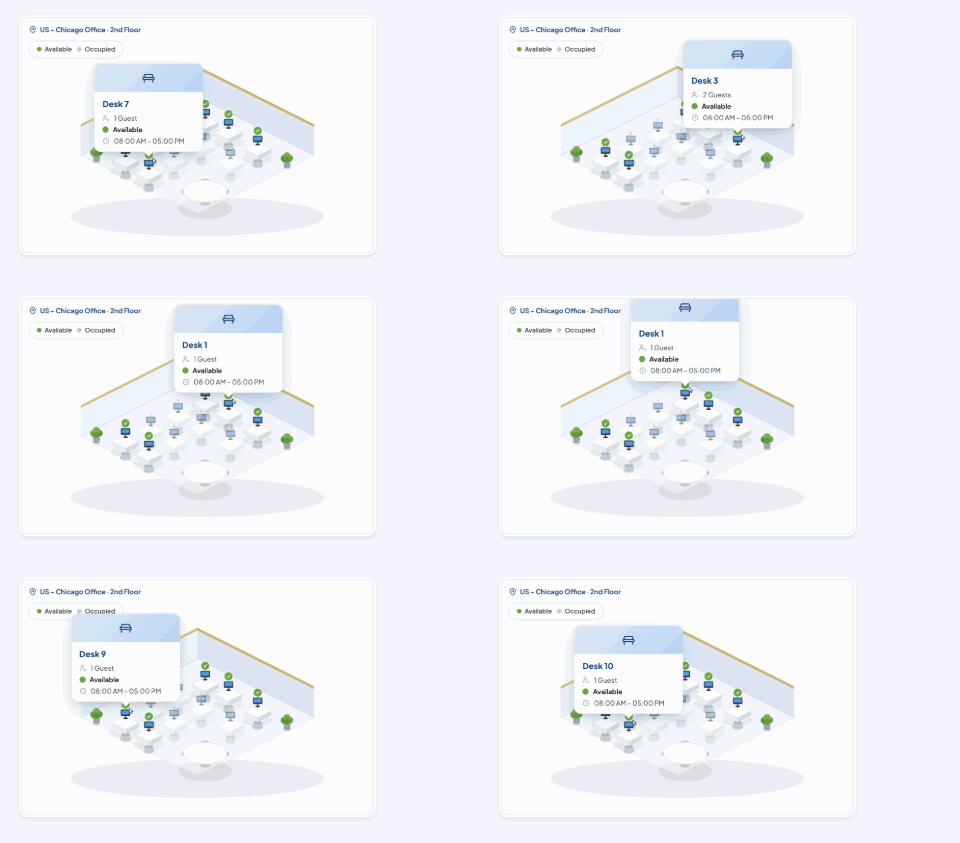
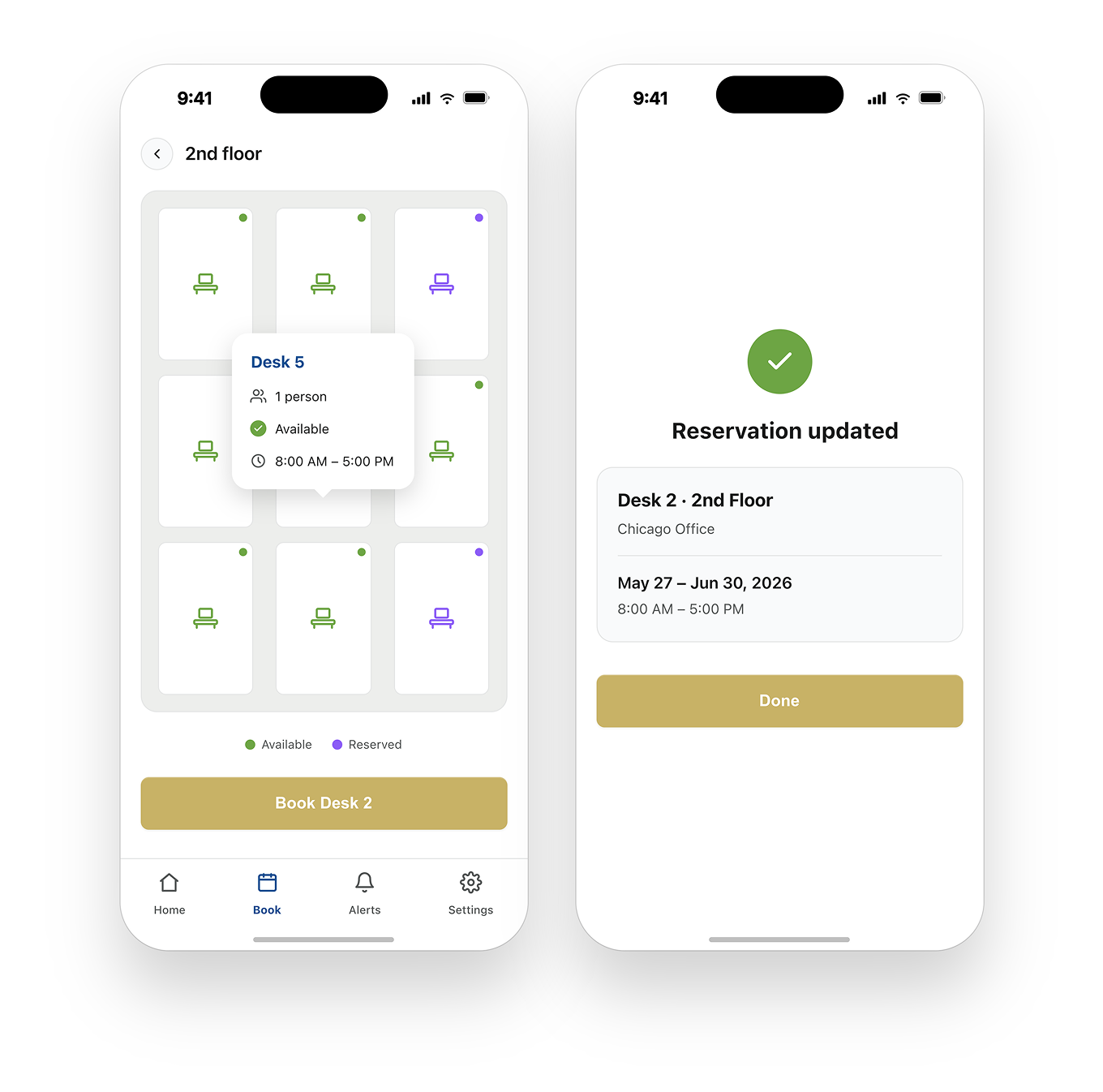
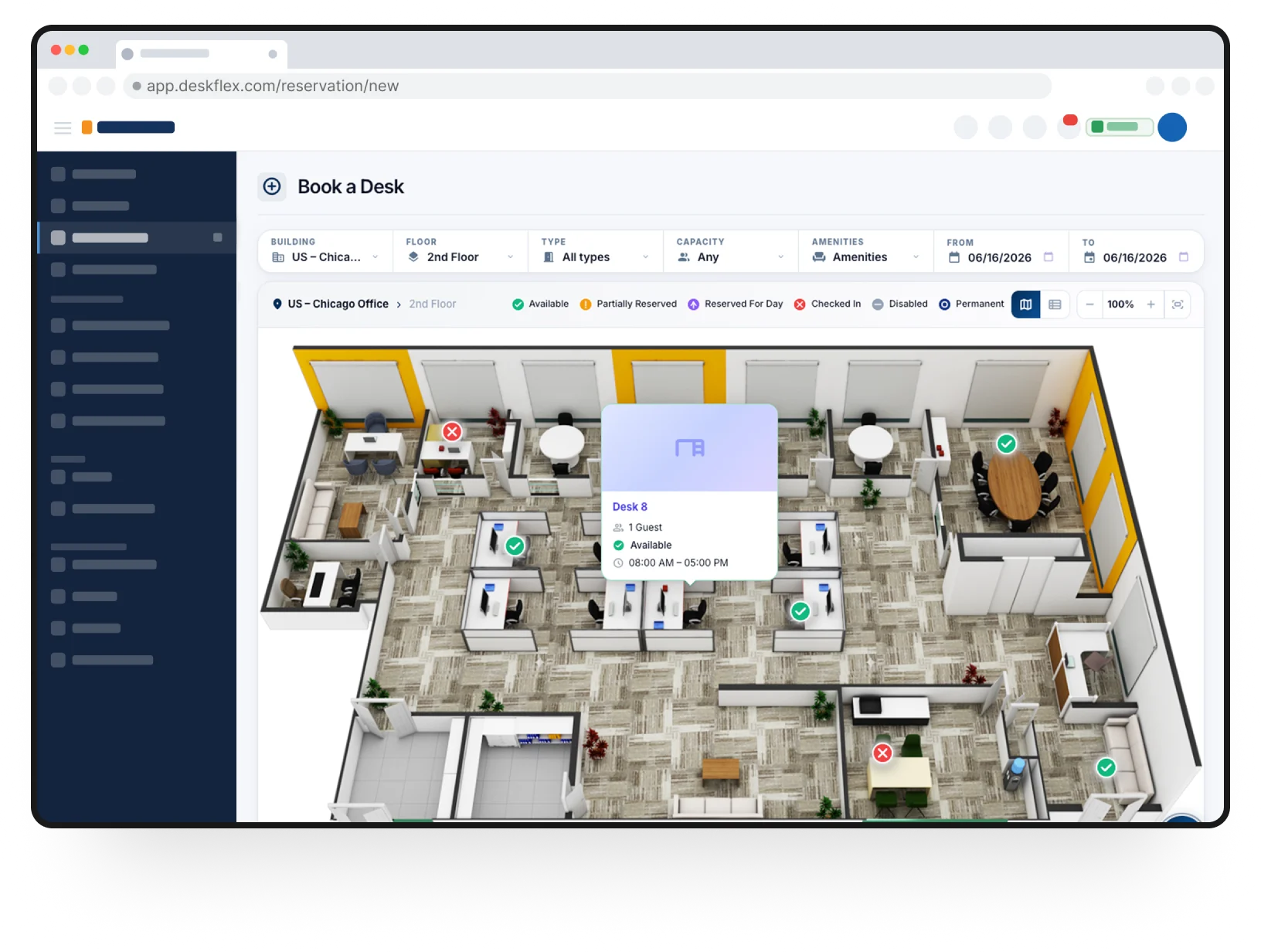
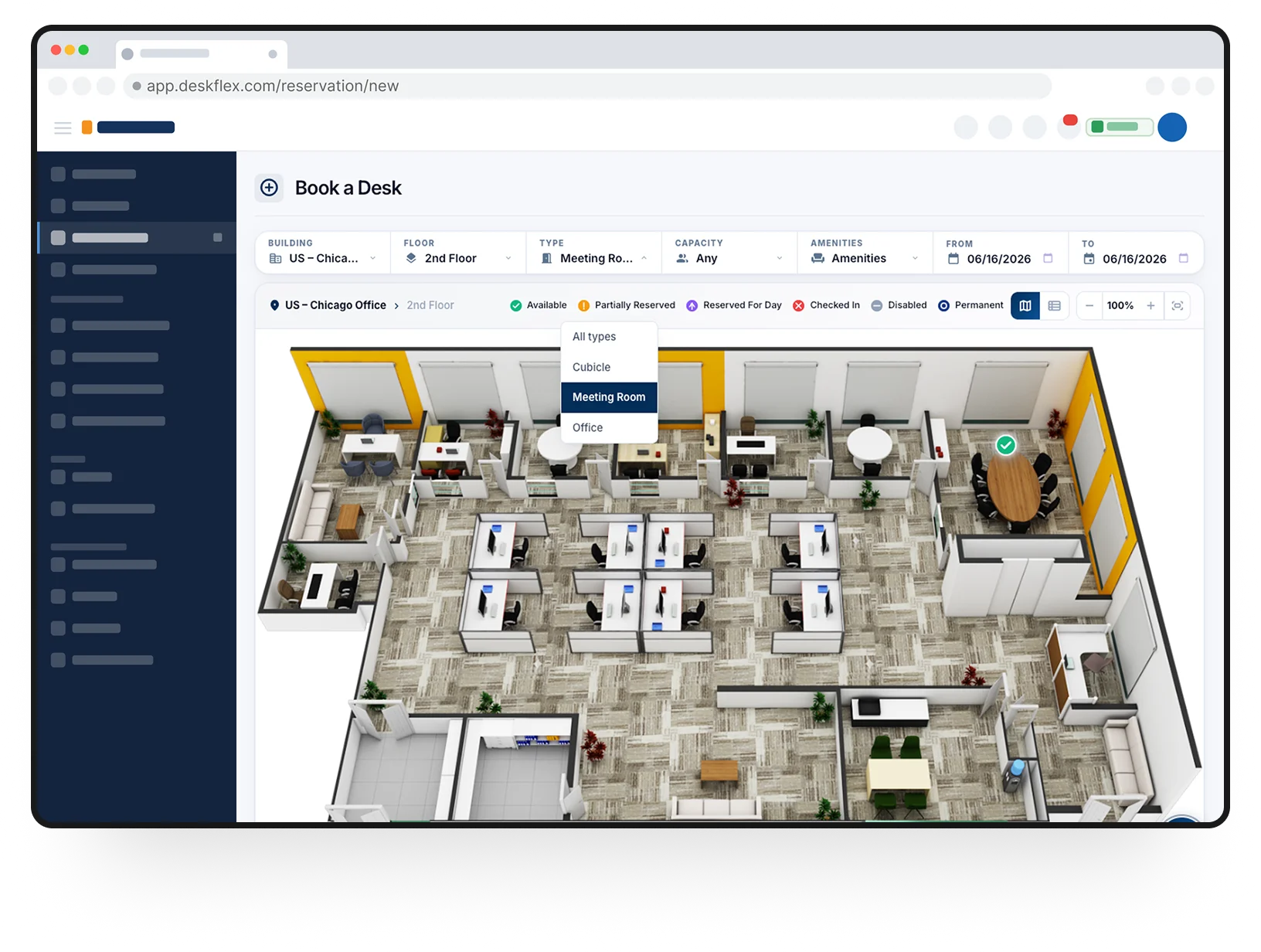
Employees need to know what is available right now: which desks are free, which rooms are open, where teammates are sitting today. Without real-time information, flexible offices feel chaotic. With it, they feel efficient. 3D floor maps and mobile booking apps are the standard ways to deliver this.

6. Permanent assignments where they belong

Some roles need permanent desks: receptionists, accommodations cases, executives who need confidential meeting space, employees with specialist equipment. Designing flexible space without explicit carve-outs for these roles creates friction and inequity. Permanent user assignments need to be part of the model from day one.

7. Acoustic and lighting separation

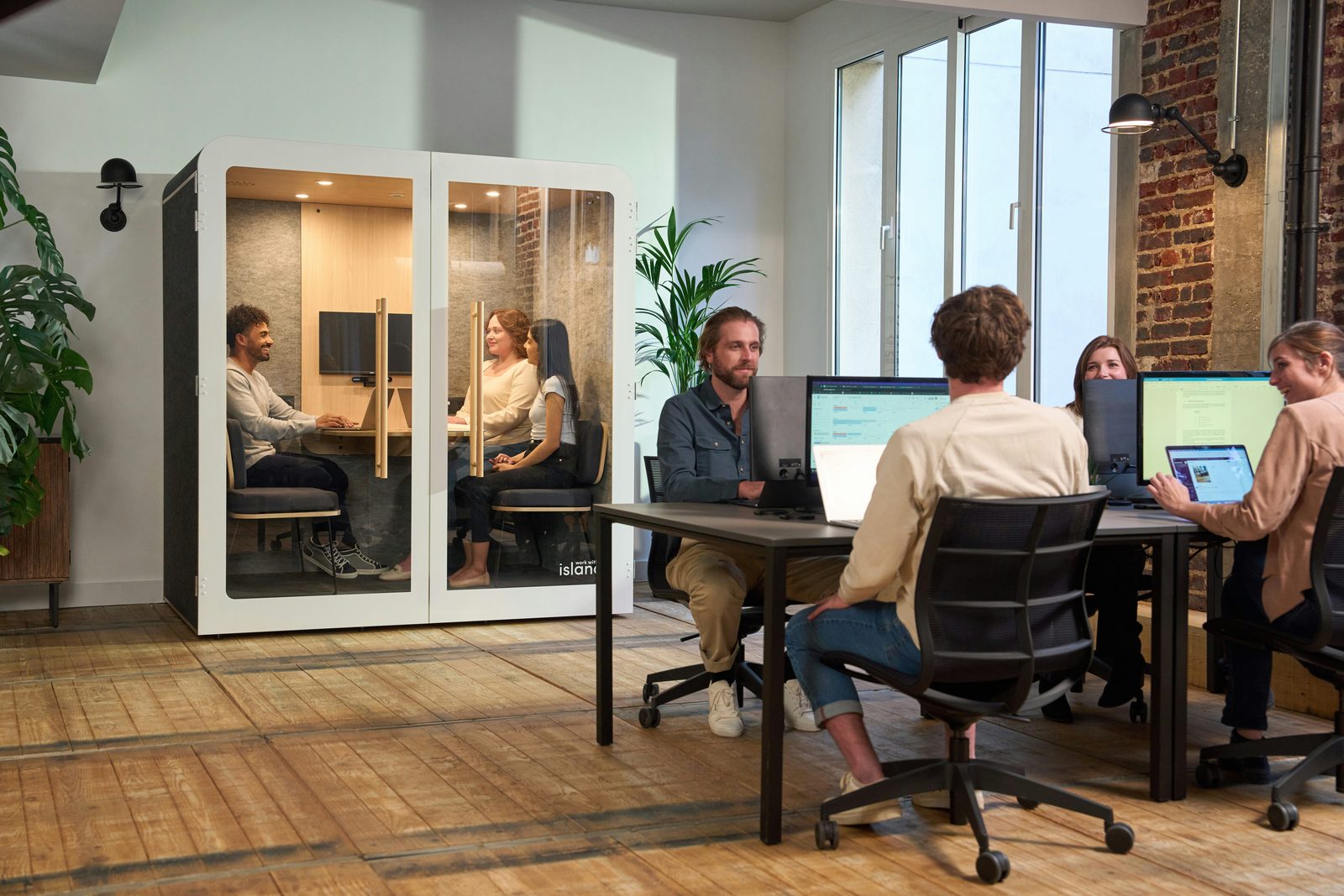
Different zones need different acoustic and lighting environments. Open plan with no acoustic separation is the most common design failure in flexible offices. Solutions include acoustic baffles, phone booths, glass partitions, and lighting that signals zone type (warm and dim for focus, bright for collaboration).

8. Hospitality, not just function

The most successful flexible offices feel more like hospitality spaces than corporate facilities: comfortable furniture, plants, good coffee, decent lighting, attention to what makes people want to be there. The investment is small and the experience difference is large.

Flexible Office Space Layout: 5 Common Approaches

Five layout patterns dominate flexible office design in 2026. Each has trade-offs.

Layout 1: Open plan with zones

The most common approach: a single floor with defined zones for focus, collaboration, calls, and meetings, separated visually and acoustically but not by walls. Pros: highest density per square foot, supports spontaneous interaction. Cons: noise control is hard, focus zones often degrade.

Layout 2: Neighborhood model

Floor divided into team-specific neighborhoods. Each neighborhood has a desk cluster, a small meeting space, and a phone booth. Pros: team coordination is easy, employees know where their team is. Cons: less flexibility for cross-functional work, requires anchor-day scheduling to fill neighborhoods.

Layout 3: Hub and spoke

Central collaboration hub (kitchen, lounge, café-style seating) surrounded by quiet zones, phone booths, and meeting rooms. Pros: high-quality social and collaboration space, clear separation from focus work. Cons: more square footage required, central hub can dominate.

Layout 4: Activity-based working

Floor divided strictly by activity type: deep focus zone, collaboration zone, call zone, social zone, meeting room cluster, quiet library zone. Employees move between zones based on what they are doing. Pros: maximizes the work-space match. Cons: requires strong cultural adoption, employees who do not move feel out of place.

Layout 5: Coworking style

Mix of dedicated desks, hot desks, private offices, meeting rooms, and lounge space, all in the same floor. Pros: most flexibility, accommodates different work styles in one floor. Cons: visually busy, requires good wayfinding.

Most mature flexible offices blend two or three of these. The right pattern depends on team mix, work mode distribution, and culture.

How to Manage Flexible Office Space?

Designing the flexible office is half the job. Running it day to day is the other half. Six management practices separate successful flexible offices from chaotic ones.

1. Use a workplace platform to operate the space

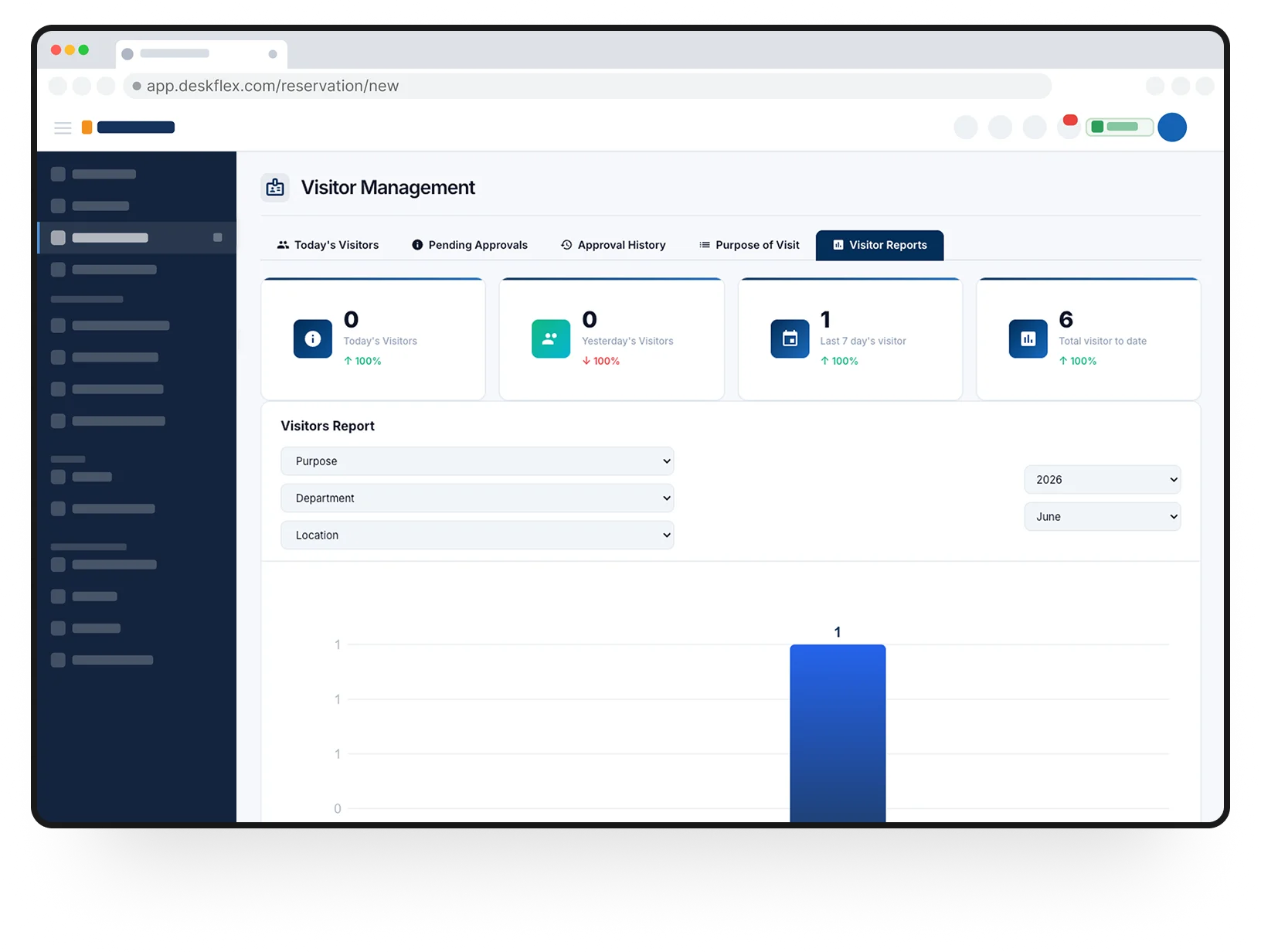
Spreadsheet-based desk booking and email-based room scheduling fail at scale. Modern flexible offices run on a workplace platform that handles desk booking, room scheduling, visitor management, check-in, and analytics in one integrated system. DeskFlex’s platform is purpose-built for this.

2. Enforce check-in to prevent no-shows

Booked-but-not-occupied desks block other people from using them. Enforce check-in within 30 to 60 minutes of the booking start, with auto-release of unused bookings. This single rule drops no-show rates from 15 to 25 percent down to under 5 percent. DeskFlex’s check-in / check-out handles this natively.

3. Anchor days for team coordination

Without anchor days, hybrid attendance distributes randomly across the week and teams rarely overlap. With anchor days, teams come in together on specific days. The space feels populated, collaboration happens, and the office becomes worth coming to.

4. Active zone management

Walk the office. If quiet zones are getting noisy, post signs, talk to managers, adjust the layout. If meeting rooms are constantly double-booked, change the booking rules. Active management catches small problems before they become entrenched.

5. Measure utilization quarterly

Booking data, attendance data, room usage, no-show rate, peak vs. trough day attendance, zone usage. Review quarterly. Make data-driven adjustments to layout, policy, and technology. Analytics tools make this visible and actionable.

6. Collect employee feedback continuously

In-app feedback, quarterly pulse surveys, regular one-on-ones with the workplace experience team. The employees using the space know better than leadership what is working and what is not. Build feedback loops that actually feed into decisions.

Flexible Office Space Examples and Ideas

Examples from across industries show how flexible office space can be implemented well.

Examples by company size

  • Startups (under 50 people): Single floor with mix of hot desks, two meeting rooms, two phone booths, kitchen / lounge. Often runs as coworking-style without much zone enforcement. Total square footage 2,000 to 5,000 sqft.
  • Mid-sized (50 to 500): Multi-zone office with desk booking (hoteling), team neighborhoods on anchor days, dedicated focus and collaboration zones, multiple meeting rooms, several phone booths, café and lounge spaces. Square footage 10,000 to 50,000 sqft.
  • Enterprise (500+): Multi-floor offices in multiple cities, each with full activity-based working layouts, team neighborhoods, executive offices, comprehensive meeting room mix, full service amenities, and centralized workplace technology connecting all locations.

Industry-specific examples

  • Tech companies: heavy on collaboration zones, abundant phone booths, casual seating, high desk-to-employee ratio (0.6 to 0.7) to support team-day spikes.
  • Professional services: balance of focus zones and meeting rooms, partner / executive offices kept private, client-facing meeting space prioritized.
  • Healthcare administrative: balance of standard desks and quiet zones, with HIPAA-compliant meeting rooms for confidential conversations and clear separation from clinical spaces.
  • Education: faculty offices preserved for teaching staff, hot desks for visiting researchers, large open spaces for graduate students, formal meeting rooms for committee work.
  • Government: greater emphasis on private offices, secure meeting spaces, on-premise IT infrastructure, and visitor management at every entry.

Design ideas worth considering

  • Quiet libraries: completely silent zones, designed like an actual library
  • Standing-only zones: tall tables, no chairs, for short standup meetings
  • Outdoor work areas: where climate permits, terraces and outdoor desks
  • Phone booths in volume: most flexible offices under-provide phone booths; mature offices have one booth per 15 to 20 employees
  • Family / parent rooms: lactation rooms, quiet rooms for caring for sick children when needed
  • Wellness rooms: meditation, prayer, brief rest
  • Equipment lockers: secure overnight storage for personal items so flexible doesn’t mean carrying everything home daily

Flexible Office Space vs Traditional Office: Which is Right for You?

The choice between flexible and traditional office space depends on six factors. Walk through them honestly.

Factor Lean Traditional Lean Flexible
Attendance Pattern Consistent, daily, predictable Variable, hybrid, day-to-day variation
Work Mix Mostly one type (all focus, all collaboration) Diverse (mix of focus, collaboration, calls)
Team Size Growth Stable Growing or shrinking
Real Estate Lease Cycle New lease, long commitment Lease renewal coming up
Confidentiality / Security High requirements Standard
Company Culture Hierarchical, formal Collaborative, informal
Budget for Build-Out Available, multi-year amortization Limited, prefer OpEx

Most knowledge-work organizations land in the lean flexible column on at least four of the six factors, which is why flexible office models have become dominant. Organizations in regulated industries such as legal, finance, government, and healthcare often retain more traditional elements while still adopting selected flexible workplace features.

How DeskFlex Helps with Flexible Office Space

For organizations operating their own internal flexible office space, DeskFlex is built for exactly that. The platform consolidates the operational layer that makes flexible offices actually work:

For organizations renting external flexible office space from providers like WeWork, Regus, or IWG, DeskFlex is not the right tool. Those providers handle the space and the daily operations through their own platforms.

Book a 30-minute demo if you are designing or running your own flexible office and want to walk through how DeskFlex fits.

Conclusion

Flexible office space has moved from a niche option to the default for knowledge-work organizations in 2026. The two meanings of the term (external coworking and internal flexible design) cover different use cases for different companies, but both produce the same broad outcome when implemented well: real estate efficiency, productivity gains, retention improvements, and better hybrid work support.

For organizations evaluating external flexible office space, the right next step is shortlisting coworking and serviced office providers in your target geographies based on amenities, pricing, and contract flexibility. For organizations designing or operating their own internal flexible office space, the right next steps are honest measurement of current attendance and utilization, deliberate design across the eight principles in this guide, and deployment of a workplace platform that integrates desk booking, room scheduling, visitor management, and analytics.

If you are designing or running your own flexible office space, DeskFlex consolidates the operational layer into one platform, with cloud and on-premise deployment options for organizations with specific compliance requirements. Book a 30-minute demo to see how it fits your floor plan and policy.


Frequently Asked Questions (FAQs)

Flexible office space is any workspace arrangement that adapts to changing needs rather than fixing each employee to a permanent desk in a permanent layout. It covers two distinct things: external flexible workspaces (coworking, serviced offices, on-demand spaces rented from providers like Regus, WeWork, or IWG) and internal flexible offices (your own office redesigned with hot desks, hoteling, neighborhoods, activity-based working zones, and reconfigurable layouts). The defining characteristic of flexible office space is that where and how employees work can change to match what they are doing, rather than being locked to a single fixed desk.

The biggest differences are commitment, layout, and adaptability. Traditional offices typically require 5 to 10 year leases with significant upfront capital expenditure on build-out and furniture. They assign each employee a fixed desk and a fixed work mode. Flexible office space (whether external or internal) reduces commitment through shorter leases and shared resources, provides variety of work spaces matched to different tasks, and can scale up or down as team size and work patterns change. Traditional offices optimize for predictability; flexible offices optimize for adaptability.

The eight main types are:

(1) hot desking, shared seating without reservation;

(2) hoteling, shared seating with advance booking;

(3) activity-based working, spaces designed around activities rather than employees;

(4) team neighborhoods, zones reserved for specific teams;

(5) coworking spaces, shared workspace open to multiple organizations;

(6) serviced offices, private offices in shared buildings with all-inclusive pricing;

(7) drop-in and on-demand workspaces, pay-per-hour or pay-per-day access; and

(8) modular and reconfigurable spaces, physically changeable layouts. Most mature flexible offices combine two or three of these types.

The six main benefits are: real estate cost reduction (typically 30 to 50 percent over two to three years per CBRE and Verdantix benchmarks), better hybrid work support, productivity gains of 15 to 25 percent through space-work matching, easier scaling up and down with team size, improved employee experience and 25 to 35 percent lower voluntary turnover, and faster talent acquisition through broader geographic reach or shorter time-to-open in new markets.

The main disadvantages are coordination friction when teammates sit far apart, daily set-up time loss of 10 to 20 minutes per employee, loss of personalization at the desk, equity issues for employees with accessibility or consistency needs, technology dependency (the platform must work or the office fails), noise and distraction when zones are not enforced, manager resistance from those accustomed to assigned seating, and hidden costs in external coworking through meeting-room and amenity charges. All are solvable with deliberate design and policy.

Usually yes, but not always. For external flexible space, the typical savings come from avoided multi-year leases, no build-out capex, and pay-as-you-go scaling. The trade-off is higher per-seat-per-month cost than a long lease would deliver at full utilization. For internal flexible space, the savings come from desk count reduction (30 to 50 percent typical) and floor consolidation, with one-time costs for redesign and ongoing costs for workplace technology. Over a three-year horizon, both routes typically save 30 to 50 percent vs. traditional fixed-seat offices according to CBRE and Verdantix data, but the cash flow shape is different.

Good flexible office design follows eight principles: variety over uniformity (at least five distinct space types), zoning with enforced norms (quiet stays quiet, phone zones are for calls), density tuned for actual hybrid attendance (0.5 to 0.7 desks per employee is typical), technology integrated not bolted on (one workplace platform covering desk booking, rooms, visitors, analytics), real-time information available to employees (mobile apps, floor maps), permanent assignments where they belong (accommodations, executives, receptionists), acoustic and lighting separation between zones, and hospitality-grade attention to comfort and amenity. The implementation choice typically blends two or three layout patterns (open plan with zones, neighborhoods, hub and spoke, activity-based, or coworking-style).

The five common layouts are: open plan with zones, neighborhood model, hub-and-spoke, activity-based working, and coworking-style. None is universally best. Open plan with zones offers highest density and supports spontaneous interaction. Neighborhood model best supports team coordination. Hub-and-spoke provides the strongest social and collaboration space. Activity-based working maximizes the work-space match. Coworking-style accommodates the widest range of work styles. Most successful flexible offices blend two or three of these patterns based on team mix, work mode distribution, and culture.

Effective day-to-day management of a flexible office requires six practices:

(1) using an integrated workplace platform for desk booking, room scheduling, check-in, visitor management, and analytics;

(2) enforcing check-in with auto-release of unused bookings to prevent no-shows;

(3) anchoring hybrid schedules so teams overlap on specific days;

(4) active zone management with walks, signage, and policy adjustments;

(5) measuring utilization quarterly and acting on the data;

(6) collecting employee feedback continuously through in-app reports, surveys, and one-on-ones. Without these practices, even a well-designed flexible office quickly degrades into chaos.

Mature flexible offices typically run a desk-to-employee ratio between 0.5 and 0.7, meaning between half and two-thirds as many desks as employees. The right ratio depends on attendance distribution: organizations with strong anchor-day discipline can run lower ratios (0.5 to 0.6); organizations with variable attendance and high peak-day demand need higher ratios (0.7 to 0.8). Start conservatively (0.7 to 0.8 in year one), measure actual attendance for two quarters, then adjust downward as confidence in the data grows and the anchor-day pattern stabilizes.

Coworking is one specific type of flexible office space, not a synonym. Coworking refers to shared workspace open to multiple organizations, typically rented by membership from a provider like WeWork or Regus. Flexible office space is the broader category that includes coworking plus hot desking, hoteling, activity-based working, serviced offices, drop-in workspaces, and reconfigurable spaces. All coworking is flexible office space, but not all flexible office space is coworking. An internal flexible office (your own company office redesigned for flexibility) is not coworking even though it is flexible.

Internal flexible office space requires a workplace management platform covering desk booking, room scheduling, visitor management, check-in / check-out, and analytics, integrated with calendar tools (Outlook, Google), identity (Okta, Active Directory), and collaboration platforms (Microsoft Teams, Slack). For external flexible space (coworking), the provider’s own platform handles the operations. The most important capabilities are mobile-first booking, real-time availability, team-presence visibility, and auto-release of no-show bookings.

Yes, with caveats. Startups under 50 people typically benefit from external coworking or serviced office space because the lease commitment and build-out cost are inappropriate at that scale. As teams grow past 50, the maths shifts: a dedicated office with internal flexible design (hoteling, neighborhoods, activity-based zones) typically becomes cheaper per seat and gives more control. Most growing companies move through coworking, then serviced offices, then their own flexible office, as headcount and tenure grow.

For external flexible office space, the largest providers are WeWork, Regus (part of IWG), Industrious, Mindspace, Servcorp, Knotel, and CIC, plus thousands of local independent coworking spaces. Each has different geographic coverage, amenity profiles, and pricing. JLL, CBRE, Cushman & Wakefield, and Savills all publish ongoing market reports comparing flex office providers. For internal flexible office space management, the leading workplace platforms include DeskFlex, Robin, OfficeSpace, Condeco (Eptura), Yarooms, and SpaceIQ (Eptura). See our workplace management software comparison for detailed reviews.